Israel-Palestine Letter from NEYM Clerks, October 2025

Acting on the request of New England Yearly Meeting Sessions 2025, a called meeting of New England Friends, convened by the Permanent Board, was held on October 18, 2025 to seek where we were led to act on the ongoing crisis in Palestine and Israel. The full minutes of the meeting can be found here. The deep and rich worship of those gathered at that meeting led us to find unity on a minute of actions and queries (see Minute 25-*1). While it cannot be expected that we all act on every one of the nine points in this minute, I ask that you bring this minute to your monthly meeting and consider which actions speak to your meeting and find ways to bring them alive.  A minute is just words on paper until we bring them to life.

The gathered meeting found unity to endorse the Joint Quaker Organizations Statement on genocide in Gaza; a powerful statement that calls on its signatories and countries world-wide to take steps that will end the cycle of violence and violations of human rights in Israel and Palestine.  By joining with many other Quaker bodies, we bring a united voice saying, “We hold in the Light all suffering peoples and leaders, praying they choose justice. In

Palestine and Israel, peace built on equality is the only path forward.” (see Minute 25-*2)

The final minute of the called meeting charged the Presiding Clerk, the Clerk of Permanent Board and the Israel-Palestine Resource Group to convene to explore, in consultation with those with experience in the region and who could provide context on the ground, the idea of sending witnesses to Gaza from the Yearly Meeting (see Minute 25-*3).  After this consideration, this group will bring a recommendation forward to Permanent Board for their discernment. Details and advance documents for the Permanent Board meeting will be posted here when available. 

Yours in peace, Phillip Veatch, presiding clerk; Susan Davies, clerk, Permanent Board

Minute 25-*1 from Called Meeting on Gaza held October 18, 2025

1. Engage with the AFSC Palestinian Program in their Fall 2025 efforts:  Read, Mourn, Learn and Act; and consider taking up steps in the program in your monthly meeting.

https://prod.cdn.everyaction.com/emails/van/AFSC/AFSC/1/57559/TUCLSb5NCX6LNQwBLPLa6Bi-CMcGhI4w94PMX0Rx_DL_archive

https://afsc.org/news/6-ways-you-can-support-palestinians-gaza

2. Support Jewish neighbors

These two years have been deeply challenging in the Jewish Community.  Jewish Voice for Peace (JVP) is an incredible organization, but for years it has been demonized by APAIC  (the American Israel Public Affairs Committee )and others, so it isn’t always easy to turn to.  There are increasing numbers of individuals who are horrified by what is being done supposedly in their name.  It can be incredibly hard to speak up, but it is happening.  How do we as individuals reach out to these folks and help them find their voices?  What support do they need? 

How do we support our Jewish neighbors who are targets of antisemitic actions? How can meetings and individuals reach out to Jewish communities and be clear of our support for their human rights and dignity regardless of political affinities?  

jewishvoiceforpeace.org

3. Learn more about tax resistance and how to support those making this choice.

Next conference is November 7–9, 2025 at Worcester Friends Meetinghouse

4. Support those in or considering military service who struggle with conscience

https://girightshotline.org.

https://quakerhouse.org

5. Travel to the area and bear witness to the suffering. Contact us at https://neym.org/israel-palestine-resource-group to connect with those who have.

6. Provide financial support for the relief of suffering:

Palestinian Children’s Relief Fund, https://www.pcrf.net/

AFSC Gaza relief  https://afsc.org/news/afscs-gaza-emergency-relief

Support Ramallah Friends School in the West Bank, which lost US AID funding:

https://www.rfs.edu.ps/en

7. Invite your Meeting to hold this discussion:

Peace and Reconciliation 

Do you “live in the virtue of that life and power that takes away the occasion of all wars”? 

Do you faithfully maintain Friends’ testimony against military preparations and all participation in war, as inconsistent with the teachings and spirit of Christ? 

Do you  strive to increase understanding and use of nonviolent methods of resolving conflicts? 

Do you take your part in the ministry of reconciliation between individuals, groups, and nations? 

When discouraged, do you remember that Jesus said, “Peace is my parting gift to you, my own peace, such the world cannot give. Set your troubled hearts at rest, and banish your fears”? John 14:27 NEB

(NEYM 1985 Faith and Practice, Query 12)

8. Discussion of Britain Yearly Meeting’s Statement on Genocide in Gaza

Adapted for United States Friends by Quakers for Peace:

https://docs.google.com/presentation/d/1w7u1Gr_ZXMeQ9Nj1JzJQnIaQe0Y1r8F4/edit?slide=id.p1#slide=id.p1

9. And, finally, how do we hold ourselves accountable?  Can the Israel Palestine Resource Group assist Meetings and Quarters in discerning what is ours to do?

Friends approved this minute.

Minute 25-*2 from Called Meeting on Gaza held October 18, 2025

The clerk asked if the body gathered was comfortable having the Presiding Clerk and the Yearly Meeting Secretary endorse the AFSC statement, mindful of the Policy on Public Statements (2015-57).  Quakers discern genocide is occurring in Gaza and urge courageous action.”

Friends approved this minute.

NEYM to Hold Workshops on Meeting Care Day, November 15, Bedford, MA

NEYM will hold a series of workshops on November 15, 2025, 9:00 to 3:00, that may be of interest to Friends. Schedule of the day and additional information below

Register Now

Location

First Parish Church
75 Great Rd
Bedford, MA 01730
United States

Here is the list of workshops to be held:

Quaker Group Discernment: Clerking, Recording, and Active Participation
Great for: New and experienced committee, board, or meeting clerks. New and experience committee, board, or meeting recording clerks. Any Friend who wants to develop & deepen their understanding & skills in discernment and Quaker process.
Best Practices in Nominating
Great for: Friends serving on nominating committeesAnyone who yearns to draw out gifts and grow leadership in our Quaker communitiesFriends with a concern for healthy relationships and healthy functioning in our Quaker meetings.
Setting the Table for Newcomers
Great for: Friends looking to share and hear ideas related to outreach Friends working to create a culture of welcome in their meeting. Friends concerned for connecting seekers and new Quakers with adult religious education opportunitiesFriends passionate about working towards a healthy future for our meetings.
Emerging Conversations About Ministry and Eldership in Our Meetings
Great for: Friends serving on Ministry & Counsel (or similar role) in their meeting. Any Friends seeking to enrich the spiritual life at their meetingFriends bringing questions, resources, or experiences to share related to ministry and eldership in meetings.

Details

Do you serve your local Quaker meeting? Are you looking to connect with others serving in similar roles to discuss challenges and explore best practices? Join us for Meeting Care Day, an in-person event featuring multiple workshop options related to specific service areas. Before and after the morning and afternoon workshop sessions, we will gather for worship and fellowship, making for an energizing day.

Schedule

  • 9:00 Arrivals, fellowship, coffee & refreshments
  • 9:30 Welcome & opening worship
  • 10:15 Part one workshops
  • 11:45 Lunch (bring your own)
  • 12:45 Part two of workshops
  • 2:15 break
  • 2:30 Closing worship
  • 3:00 Goodbyes

Workshops

All workshops are three hours, broken into two 90-minute sessions. Participants choose one workshop to participate in throughout the day. This year, participants can choose from one of four workshops:

Best Practices in Nominating

Nominating is an essential way we draw out gifts and grow leadership in our Quaker communities. Nominators sit at the intersection of the meeting’s needs and individual spiritual journeys. This work is deeply relationship-based and involves seeing the “big picture” of our ever-evolving meeting communities as well as the details involved in getting various tasks done. In many of our meetings, nominators quietly and lovingly engage in the one-on-one conversations that help our meetings thrive. This workshop,  which will be of special interest to Friends serving on nominating committees, will provide a place to share best practices and unpack challenges in nominating. Facilitated by Lucy Meadows (Beacon Hill) and Jackie Stillwell (Monadnock).

Quaker Group Discernment: Clerking, Recording, and Active Participation

Join New England Friends’ new Presiding Clerk Phillip Veatch (Fresh Pond)  and other Friends to develop and deepen skills in Quaker group discernment and decision-making processes used in our meetings, organizations, and committees including the particular functions of clerk and recording clerk. This workshop is designed to be of use to both those new to and experienced with Friends’ practices. Whether you are currently serving as clerk or recording clerk in a local meeting or on a committee or you are hoping to strengthen your participation in discernment outside a particular role, you are welcome.

Emerging Conversations About Ministry and Eldership in Our Meetings

What conversations regarding ministry and eldership are happening (or not happening) in our meetings? What guidance, practices, and resources are Friends able to offer one another in seeking to enrich the spiritual life within our meetings? What new challenges and opportunities are emerging, as we live into these unsettled times? Whether you serve on your meeting’s Ministry & Counsel committee or otherwise hold a concern for the spiritual health of your meeting, we invite you to join an exploratory conversation and resource-sharing opportunity. Facilitated by Janet Hough (Cobscook), clerk, NEYM Ministry & Counsel.

Setting the Table for Newcomers

In each of our local communities, there are spiritually hungry seekers yearning to connect. How can we extend a living invitation and set the table to feed newcomers and long-time Friends alike? Join us for a conversation about outreach, welcome, religious education, building belonging, renewal, and change in our Friends communities. Conversation starters will include Emily Mason who followed a leading to begin the Orchard Hill Worship Group in New Hampshire and Phil Fitz who was led to develop the Elements of Quakerism course to move Friends past Quakerism 101 in his home meeting in Northampton, MA and beyond, and Regina McCarthy who has been a part of Wellesley Meeting’s varied efforts to welcome newcomers and families. Facilitated by Program Director Nia Thomas (Northampton).

Ready to register? Go here.

Questions or suggestions? Contact Program Director Nia Thomas.

P&SC Urges Extra Support for Local Food Banks

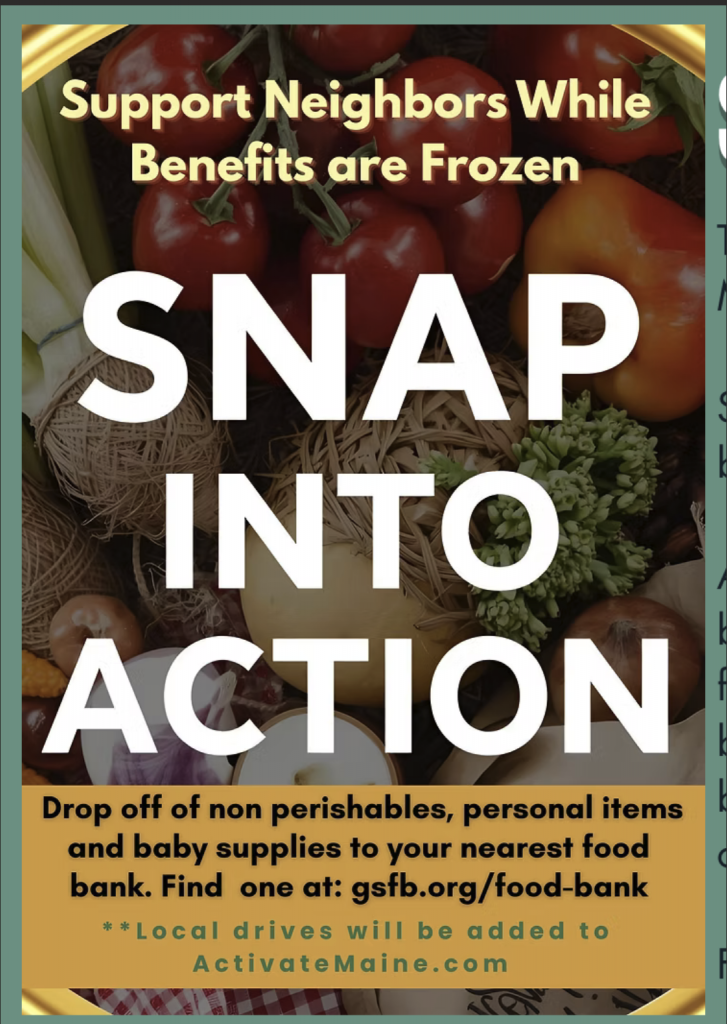
Peace and Social Concerns Committee would like to call our attention to the emerging food crisis with the interruption of SNAP benefits during the federal government shutdown. P&SC urges DFM folks to be especially generous in contributions to local food banks and pantries.

Here’s a statewide initiative to support food banks.

https://www.activatemaine.com/snap?link_id=5&can_id=f8c7fdc7b411757f5f62087d9699f2af&source=email-we-did-it-38-of-mainers-rose-up-see-the-counts&email_referrer=email_2953013&email_subject=snap-disruption-snap-into-action&&

“At the Global Matriarchs Gathering,” by Linda Muller, Nancy Bouffard and Shelley Randall

At Durham Friends Meeting on October 19, 2025, three women from the Meeting shared reflections on their experiences at the 4th Annual Global Matriarchs Gathering sponsored by the Land Peace Foundation.

from Linda Muller:

This August women gathered at the Land Peace Foundation in Monroe.  This was the fourth Global Matriarchs Gathering and my second. 

The spiritual influences on me are an amalgam of many interactions with indigenous women over the years, including the series of Healing Turtle Island gatherings some of you are familiar with and the recent Walk for Peace and Friendship. 

Much of this activity is now being framed as, “let’s create the world we wish to inhabit and pass down to our grandchildren”. And” let’s show our deep gratitude to our earth, for generously sustaining us from our very origins”.

At the Matriarchs Gathering-we first acknowledged that we humans are all one family and that women have a unique spiritual role across cultures.  We bring forth the next generation of children and we have a special responsibility to attend to that which sustains all aspects of life.

We acknowledged that we are confronted, now, with men needing our attention, in a manner that conveys self and mutual respect.  We noted that some tender hearted men we know are suffering under cultural influences to restrict emotional display to anger and violence, only. We see that their impulse to nurture, provide and protect is often thwarted by our economic system.

We acknowledged the concept of ‘rugged individualism’, which may lead us to to believe we’re to solve our own problems individually. This concept also specifies that if we do not succeed in tending to our own needs (with the limited resources of our nuclear families) the problem is due to our lack of initiative.

Special challenges for those of European ancestry were noted; that centuries of violence, feudalism (with its repression of workers on the land),  conquest and the forming of kingdoms left a trail of forgotten land grabs and trauma many generations deep. Periodic changes in attitude about religion and the role of women and earth based spirituality; the emergence of the institution of Christianity with its Inquisition, more conquest and displacement, witch burnings and torture generated fear and rejection of diversity. 

When our relatives immigrated to Turtle Island (North America) many ties to our ancestry were severed, no cell phones then. Many of us have lost the knowledge of our ancient ancestors, their community based celebrations, ceremonies and earth based spiritual practices. This can leave us feeling like we’re standing in a  open field with no protection but the naked knowledge of science. Balancing this with our spiritual, emotional and physical well-being requires community, ceremony, celebration, belonging, sharing  and caring for each other.

As we move forward now, rigid gender roles and rugged individualism (medicated by the temporary satisfactions of consumerism) are not supporting the mutuality and love we need to create the world we want to inhabit. 

I came away from the Matriarchs gathering with renewed hope that: 

  • We can learn how to appreciate and benefit from all manner of human diversity. 
  • We can reject dog-eat-dog type competition, cruelty and condemnation. 
  • We can develop our emotional maturity and healing from historic trauma.
  • We can cultivate patience, listen to each other and learn better cooperation.  We can recognize science AND the need for balance with sound values and communal spiritual practices.

Acting on the world we want to inhabit is our responsibility and we each bring valuable, unique gifts and talents to this.

Thank you.

Financial Problems at Friends United Meeting (FUM)

A few days ago, Friends United Meeting sent out the following sad story. If you are not familiar with FUM, you can learn more HERE. New England Yearly Meeting (to which Durham Friends belongs) is itself oner of the member Yearly Meetings of FUM.

 October 23, 2025The North American and Caribbean Board of Friends United Meeting write:
  Dear Friends,

We will put the bad news first: at our current income and expenditure rate, FUM will not have sufficient operating funds to remain open by July of 2026.We understand that this may come as shocking news, and we’re taking some actions to improve the situation. Keep reading to learn more.The Board has been aware of the magnitude of our financial crisis for several months now; in late spring, we were startled to learn that we were not certain we would make payroll. Rather than release bad news in a piecemeal fashion, we took some time to fully understand the problem. We assessed all our various forms of income and expenditures, looked at historical trends to understand how much of our current situation is temporary and how much is an ongoing problem, asked Lloyd Stangeland of Iowa Yearly Meeting to serve as our temporary CFO, and worked to reconcile bookkeeping errors.Over time, overall giving to FUM has risen—especially for designated ministry work. What has not kept pace is support for the Ministry Support Fund, which covers the administrative expenses of FUM’s work. While most of our individual ministries have sufficient funding for themselves, for the past several months our administrative expenses have exceeded income by an average of about $34,000 a month. In the past twenty years, contributions from Yearly Meetings that funded our administrative work have decreased significantly. Individual donations have risen, but not quickly enough to make up the difference. The costs of doing our work have risen tremendously. We also experienced unexpected complications with a transfer between bookkeeping systems, which obscured the seriousness of our financial predicament.We, the Board, are profoundly sorry to Friends for the role our own inaction has played in this crisis. Our audits have not been done in a timely fashion, internal financial controls have been missing, and we did not ensure that good accounting practices were being followed. We have not been careful enough in reviewing financial information given to us or in developing the ability of new board members to understand FUM’s complex financial structure. In response to this crisis, we are taking several steps…
  Read the rest of the letter from the Board here (link opens as a PDF).

If you have questions, you can use the Contact List below to get in touch with your representatives or other members of the Board. The Board is meeting in a called session on Friday, October 24th, to consider the Fiscal Year 2026 budget. Please pray that Board members will be open to hearing God’s wisdom and able to hear how the Spirit is calling Friends forward.In Peace,
Sarah Lookabill
Presiding Clerk of the Friends United Meeting Board
Resource Documents (links open as PDFs): Further Financial Information North American and Caribbean Board Contact ListCopyright © 2025 Friends United Meeting, All rights reserved.

Introduction to Quakerism begins November 9

From Ministry and Counsel:

On November 9 we will begin our adult education program with an introduction to
Quakerism.

The sessions will be held on the second and fourth Sundays from 9:30 to 10:15 from
November through March, both in the meetinghouse and on Zoom. Leslie and Joyce will be the
initial facilitators. After the first session we will focus on the Quaker testimonies as presented in
Faith and Practice, with sharing about how particular testimonies have influenced us.

Agenda and Materials for October 19, 2025 Business Meeting

The reports and other materials for the October 19, 2025 DMM Business Meeting are HERE.

Durham Monthly Meeting Agenda, October 19, 2025

1. Approval of September minutes

             2. Trustees

             3. Ministry and Counsel

             4. Woman’s Society

             5. Peace and Social Concerns

             6. Finance

             7. Other business

“Hold Fast the Hope That Anchors the Soul,” by Leslie Manning

References and links from Leslie Manning’s message at Durham Friends Meeting, October 12, 2025.

“Hold fast the Hope that anchors the soul, which is sure and steadfast, that you may sail above the world’s seas.” George Fox’s Letter to Friends in America (Epistle 314). [Note: Fox’s Epistle to Friends in America is based in Hebrews 6:19]

New England Yearly Meeting Called Meeting on Gaza   Sat. October 18, 3-6 PM on Zoom: https://neym.org/events-calendar/2025/10/called-meeting-gaza

 Statement from Eight Quaker organizations on Genocide in Gaza: https://drive.google.com/file/d/1uOryTVQSzVIhsGfyvJC_Z0yeHy3QQN1F/view

Quakers and the Holocaust: https://encyclopedia.ushmm.org/content/en/article/quakers

Falmouth Quarter to Meet October 25, 2025, 9:30 to 3:30

Falmouth Quarter will meet on October 25th from 9:30 – 3:30 at Durham Meeting Meeting (or by zoom, link password 1775). We invite you to come and share about the life and spirit in your meetings. Our hope is that our entire time together is a time of worship, with laughter, business, connections and fellowship. All are welcome.

We invite you to come and share about the life and spirit in your meetings.  Our hope is that our entire time together is a time of worship, with laughter, business, connections and fellowship.  All are welcome. 

The schedule for our time together is:

·       9:30 gather

·       10:00 Meeting for business – agenda at end of this announcement

·       12:00 break, brown bag lunch – there is a stove, microwave and tea kettle in the kitchen.

·       1:00 Afternoon program:

Description of the afternoon program:

“Rekindle the gift of God that is in you… for God did not give us a spirit of fear, but of power, love, and self-control” (2 Tim 1:6-7).  “Behold I will do a new thing” Isaiah 43:19

We are living in different times, do we have the what we need now?  How can we find our spiritual bearings in the face of the institutional cruelty locally, nationally and internationally? What is the Truth that is needed now and how do we tell it’s story?  

We will listen to the story as told in Isaiah that the community learned to tell during the exile in Babylon, and listen to the story told in Ramallah by Jean Zaru in the present time.

Through their stories, we expect to begin to find new threads of Truth that speaks to our current condition — the story that we need today. A story that equips, empowers and encourages us.

Agenda for business meeting:

·       One of the essential responsibilities of a Quarter is to pay attention to and nurture the spiritual health, experience and  ministry in the monthly meetings of the Quarter. Please come prepared to share about the life of your meeting.

·       Report from Annual Sessions –

o   The concern brought by Falmouth Quarter about supporting LGBTQAI+ communities and especially Transgendered folks.

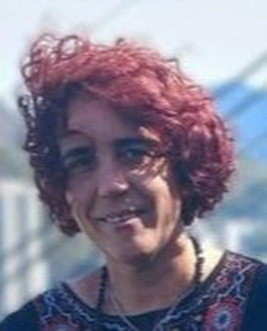
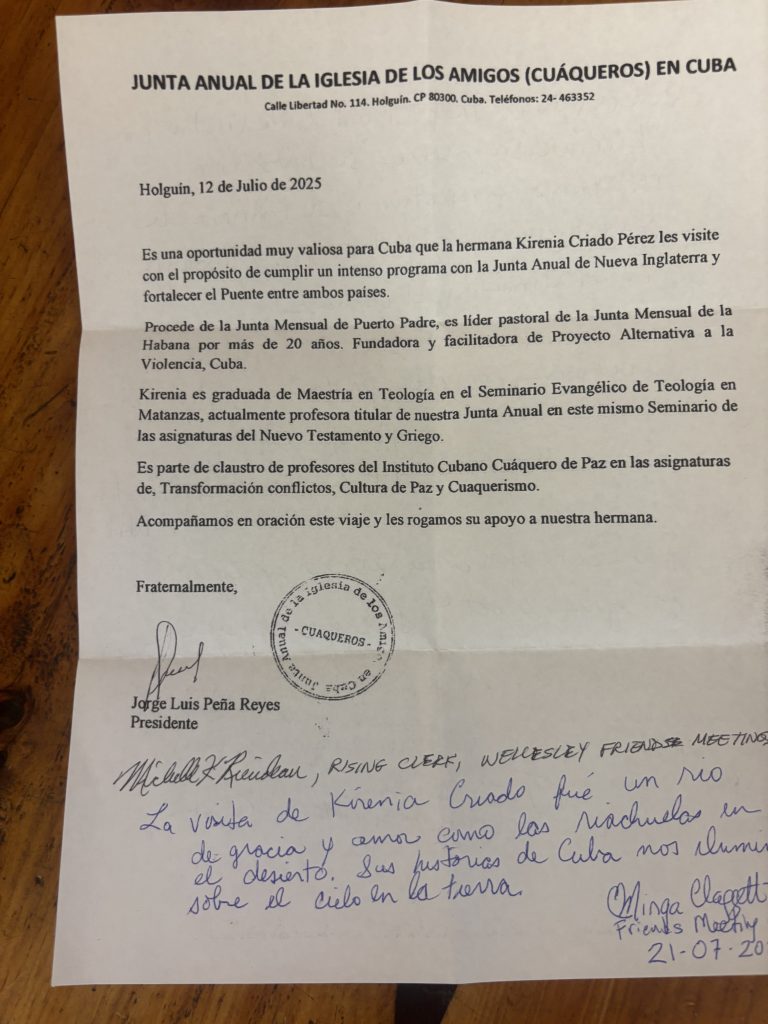
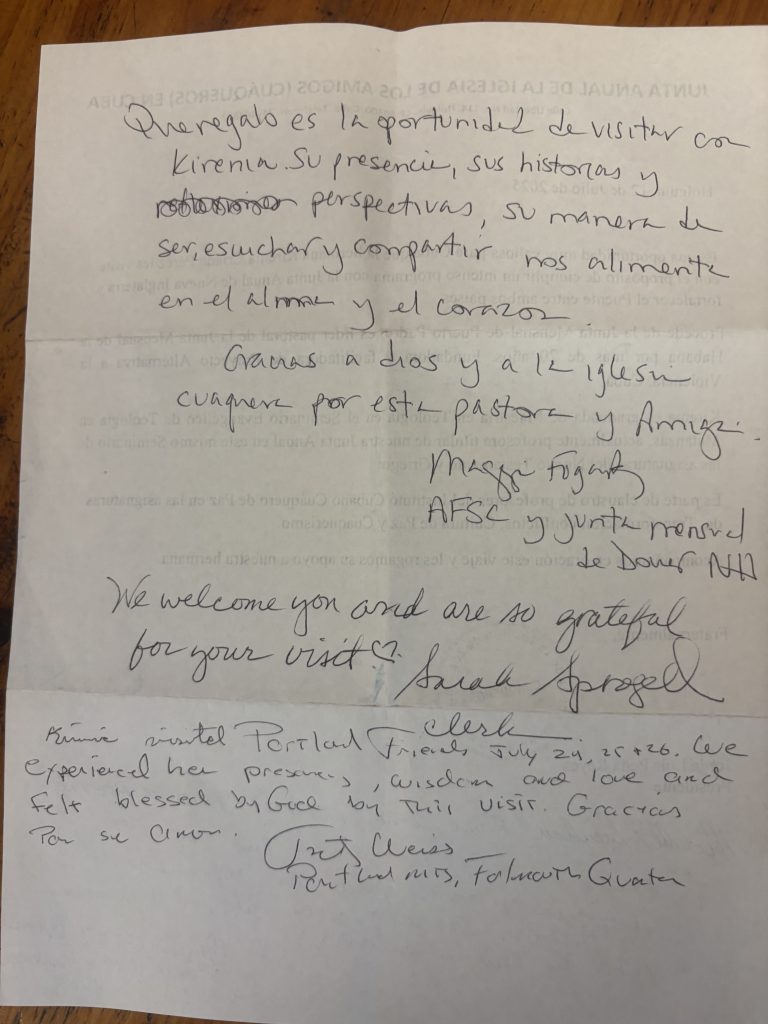
o   Our experience of the bible half hours brought by Kirenia Criado Perez

o   Other

·       Treasurers report, approving the budget, approving donations.

·       Approving the Quaker representative to the Maine Council of Churches.

·       Approving the dates and suggesting topics for Quarterly meetings for the coming year.

“Durham Friends Meeting at 250: Kindling a Fire with Gratitude” by Doug Bennett

Message given at Durham Friends Meeting, October 5, 2025, on the occasion of Durham Friends Meeting’s 250th Anniversary and also World Quaker ay 2025

Today, October 5, is World Quaker Day, a day for Quakers around the world to recognize and celebrate one another – and worship, too, in one worldwide community. Across the globe, Quakers are gathering today, holding hands with one another across the miles.  Kenya to Kansas; Norway to New Zealand; Bolivia to Brigflats in England; Durham in England to Durham in North Carolina to Durham in Maine.  We join in that celebration.  

We are also gathered today to celebrate 250 years of this Meeting.  This Meeting began before people in this country declared their Independence and founded a new nation. We do not know the exact date, but sometime in 1775, Quakers first gathered here in Durham, Maine for worship.  Those first members worshipped in the house of one or two of those earliest members.  So we have chosen to celebrate this 250th anniversary on World Quaker Day 2025.  

A celebration: is this what we are having?  We celebrate birthdays.  We do that with a cake and candles.  We celebrate the 4th of July, the beginning of our new nation.  We do that with hot dogs and fireworks.  We celebrate triumphs.  We do that with parades and cheers.  But how about a Quaker Meeting that has existed for centuries?  Is this a celebration?  Is it an occasion for taking pride?  It’s hard not to feel some pride, but should that we the center of our experience of the day?  I think we celebrate such a day with gratitude and with worship.   

There is a story here, a story of faithfulness, I’m thinking.  Just like the Bible, read cover to cover, is a story of faithfulness.  We should tell that story, but no one can tell the whole story and certainly not in fifteen minutes.  It is a story of a shared journey, and no one of us was present for the whole journey.  Certainly none of us gathered here today were present at these beginnings.  We are inheritors of those who journeyed before us, seeking and striving to build a Beloved Community.  And for that inheritance we are grateful.  

Where does the journey begin?  A long, long time ago.  

Each week when we gather, we remind ourselves that we gather on Abenaki land.  The Abenaki were here in this place for thousands of years before there were Quaker settlers here.  And we are grateful to them for their stewardship of this beautiful place.  These were our first neighbors; we’ve had many others.  

We are grateful for those neighbors, and for the many others who have been our neighbors here in the Androscoggin Valley, in a place we today call Durham.  We have neighbors farther afield, too: those who have worshipped here once or many times and now live elsewhere.  For instance we have neighbors in Cuba, at Velasco, our sister Meeting, and in Cuba Yearly Meeting.  “Love Your Neighbor” is the theme of this year’s World Quaker Day around the globe.

A little closer to the present, in 1652, George Fox preached at Firbank Fell in England to a large gathering of seekers.  Perhaps that’s the beginning of what we know as Quakerism. He gathered people in worship.   In 1657, just five years later, the small ship Woodhouse took eleven Quakers on a voyage to the Americas that eventually landed them in Rhode Island.  I think that’s a part of the story.  

Those on the Woodhouse had a fitful journey.  Robert Fowler, who built the boat and was their captain, wrote about going ashore one day.  He says, “they gathered sticks and kindled a fire, and left it burning.”  That’s pretty dodgy as a contemporary environmental practice, but it’s an arresting metaphor of tending and spreading the Light.  It’s what we do week by week, year by year:  We gather sticks, we kindle a fire, we leave it burning.  It’s a welcome we offer, and an invitation to know God’s will, gathered here with others.    

In 1661, just four years after the Woodhouse, we have the first gathering of New England Yearly Meeting.  We are grateful to be a part of New England Yearly Meeting all these years.  

1775, 250 years ago, is the first gathering of Friends in worship here in Durham.  1790 we acquire this land, purchasing this plot from a Quaker family that had purchased a larger plot.  In 1800 we built a new larger Meetinghouse.  In 1829, we built this new brick Meetinghouse, where we have gathered in worship ever since – and gathered, too, for pot-luck suppers, for singing hymns and singing folk songs, for plant sales, for fellowship – and for many, many other purposes.  We invite others to use our Meetinghouse as well.  

There is so much that has happened here over our 250 years of worship together.  

For many years there were separate entrances for men and women.  Men and women also sat separately, and they held business sessions separately, at least until 1881.  This despite women being leaders in this meeting, and among Quakers generally, right from the beginning.  I do not know when we removed the separate entrances or the sliding partition: sometime in the 19th century.  

Over the 250 years, there were schisms in Quakerism, sometimes bitter divisions.  Hicksite Quakers contended with Orthodox Quakers in the 1820s and for decades after.  But not so much here in New England.  At Durham we were relatively untouched by that schism. A few decades later, a visit from English Quaker Joseph John Guerney brought a revitalized evangelical thrust to American Quakers, and that was felt here in Maine.  Our fondness for hymn singing probably stems from that renewal.    

In 1914, we hired a pastor for the first time, a woman named Laura Ellison In doing that, we were a minority among Friends in the east coast of America, but joined with a majority of Friends around the world.  We had a pastor for about 100 years, until recently, when we decided that we would continue having a prepared message most First Days, but have no pastor.  Through all our years, we have especially wanted a time of still and silent worship in which anyone present may feel called to rise and speak as they are led by God, by the Holy Spirit, by the Inner Light.  We do not insist on any one way of speaking of the source.  

We remember fondly many of those pastors:  Dwight Wilson, Ralph Greene, Jim Douglas, Peter Crysdale, Daphne Clement, Doug Gwyn,  just some of these pastors.  We have also been blessed by our elders, people we regard as unusually faithful and wise.  This morning I’ll just name a few who departed from this life in the memory of those present:  Beatrice Douglas, Louis and Clarabel Marstaller, Margaret Wentworth, Sukie Rice.  For all these Friends, we are grateful.  

Throughout our history, we seem to have been a Meeting with a relatively wide tolerance for differing theological understandings.  Quakers in general, and this Meeting in particular, have no Creed.  There are no beliefs to which one must swear allegiance.  We trust one another in our faith journeys, our lifelong efforts to find God’s will.  We gather in silence to hear what God is saying to us, and speak what we find when we feel moved to offer ministry.   

An 1899 history of Durham describes the Friends as “quiet, industrious, honest and devout.” I suppose that was accurate as far as it went, but we’ve always been more than that.

In our shared worship, many of us find ourselves compelled to take action. That has been a thread throughout Durham Meeting’s history, but there has been quite a variety in the ‘leadings’ (that’s what we call them) to which we find ourselves drawn.  Many from Durham Friends served as missionaries both here in the U.S. and abroad, in Ramallah Palestine, for example, and in Africa.  For many years we had a vacation Bible school.  Friends from this Meeting have served important leadership roles in New England Yearly Meeting and with other Friends organizations.  We have supported an orphanage in Kenya.  

Today, our Woman’s Society offers a monthly meal at Tedford housing. We support the LACO Food Pantry; we donate to Women’s Shelters in Maine.  We maintain three cemeteries that provide for simple burial of those departed. (Just this weekend, a man named Po, born in Hong Kong, was buried in Lunt Cemetery.). We donate mittens and coats in the winter, and to funds to provide home heating for those in need.   Friends from this Meeting are active in prison ministry efforts, in peace vigils, in efforts to end gun violence, in efforts to improve education in social justice, in support for migrants and refugees.  I could go on.  

We worship as a community; have done for all our history.  We’re not just a collection of individuals; what we do, we do together.  We support one another; we gather strength in being together.  I especially appreciate what Noah Merrill, the superintendent of New England Yearly Meeting, had to say at Annual Sessions this year.  He voices our hope, our commitment:

“The Religious Society of Friends, our local meetings, were never meant to be places for the welcoming, respectful practice of hyper-individualism. The discovery and nurture of these fellowships, centered in worship, was always intended to help Friends gather and be gathered by the Spirit into local covenant communities—

  • anchored and shaped in worship, 
  • nourished in fellowship and mutual care, 
  • formed in exploration of our living tradition, and 
  • sent forth by the overflowing of Love in our hearts into service and love of neighbor in the whole of our lives. 

And all of this, all these fruits of this journey together, however imperfect, are our Testimony. 

“But there is one thing needful. We must not allow ourselves to fall into despair of the living water, even in this parched wilderness. It is the witness of countless generations, who like us suffered and struggled and mourned and rejoiced and lived and died in faith, that the Life and Power we seek is closer than breath to us, always seeking new channels through which Love might continue to come into the world.”

We’ve been here 250 years.  A long time.  We celebrate that new beginning in 1775 here today. This morning, this beautiful morning, however, I’m thinking the story doesn’t begin 250 years ago.  It doesn’t begin a few thousand years ago with the coming of the Abenaki into this valley.  It doesn’t begin at Firbank Fell with Fox speaking to gathered seekers.  It doesn’t begin with the voyage of the Woodhouse or the founding of New England Yearly Meeting.  The story begins with time itself.  It begins, as it always does and always should, with God.  

From their beginnings, Quakers have been especially drawn to the Gospel of John.  Most of you know the beginning of that Gospel, that telling of the story.   

In the beginning was the Word, and the Word was with God, and the Word was God. He was with God in the beginning. Through him all things were made; without him nothing was made that has been made. In him was life, and that life was the light of all mankind. The light shines in the darkness, and the darkness has not overcome it.

This day is an occasion for recommitting ourselves to what was done on that First Day when Friends gathered in Durham 250 years ago, and on the First Day a week later, and on the First Day after that, and so on for about 13,000 First Days.  We gather here in worship.  We gather to hear what God has to say to us.  We gather to hear what God would have us do after the rise of worship.  

Like those who voyaged on the Woodhouse, “we gather sticks and kindle a fire, and leave it burning.”

As we prepare to settle into silent worship in the manner of Friends, will you join with me in reciting a very special song of gratitude, the 100th Psalm.  It seems especially appropriate this day:

Psalm 100  (King James Version)

100 Make a joyful noise unto the Lord, all ye lands.

Serve the Lord with gladness: come before his presence with singing.

Know ye that the Lord he is God: it is he that hath made us, and not we ourselves; 

we are his people, and the sheep of his pasture.

Enter into his gates with thanksgiving, and into his courts with praise: 

be thankful unto him, and bless his name.

For the Lord is good; his mercy is everlasting; and his truth endureth to all generations.

Also posted on River View Friend

Durham Friends Meeting Minutes, September 21, 2025

Durham Monthly Meeting of Friends met for the conduct of business on Sunday, September 21, 2025, with eleven people in attendance at the Meetinghouse and two by Zoom.

1. Meeting Opening

Ingrid Chalufour, serving as clerk pro-tem, opened the meeting with an excerpt from Amanda Gorman’s poem The Hill We Climb, written for President Biden’s inauguration, January 20, 2025:

This is the era of just redemption.
We feared it at its inception.
We did not feel prepared to be the heirs
Of such a terrifying hour.
But within it we’ve found the power
To author a new chapter,
To offer hope and laughter to ourselves.
So while once we asked: How could we possibly prevail over catastrophe?
Now we assert: How could catastrophe possibly prevail over us?
We will not march back to what was,
But move to what shall be:
A country that is bruised but whole,
Benevolent but bold,
Fierce and free.
We will not be turned around,
Or interrupted by intimidation,
Because we know our inaction and inertia
Will be the inheritance of the next generation.
Our blunders become their burdens.
But one thing is certain:
If we merge mercy with might, and might with right,
Then love becomes our legacy,
And change, our children’s birthright.
So let us leave behind a country better than the one we were left.
With every breath from our bronze-pounded chests,
We will raise this wounded world into a wondrous one.
We will rise from the gold-limned hills of the West!
We will rise from the windswept Northeast, where our forefathers first realized revolution!
We will rise from the lake-rimmed cities of the Midwestern states!
We will rise from the sunbaked South!
We will rebuild, reconcile, and recover,
In every known nook of our nation,
In every corner called our country,
Our people, diverse and dutiful.
We’ll emerge, battered but beautiful.
When day comes, we step out of the shade,
Aflame and unafraid.
The new dawn blooms as we free it,
For there is always light,
If only we’re brave enough to see it,
If only we’re brave enough to be it.

2. Approval of Clerk and Recording Clerk, pro-tem.

The Meeting approved Ingrid Chalufour as clerk pro-tem.

The Meeting approved Sarah Sprogell as recording clerk pro-tem for the meeting.

3. Approval of Minutes of July 2025

The Meeting approved the Minutes of the July 21, 2025 Business Meeting.

4. Finance Committee Report — Nancy Marstaller

Nancy reviewed the attached written and numerical reports for the first and second quarters of the year. She highlighted that our income is higher than usual for this time of year because of a large financial gift received at the beginning of the year, and a large interest payment when a CD was cashed in. On the expense side, Peace and Social Concerns’ spending is high but is balanced by a grant from Obadiah Brown’s Benevolent Fund and a donation from the Meeting Care Coordinator funds. Legal fees to resolve the Babcock estate have been an unexpected expense. Despite the over-budget items, however, we continue to be in good financial shape at this point in the year.

A suggestion was made that we encourage and promote weekly giving and direct deposit giving.

5. Trustees Report — Sarah Sprogell

Please see the written report for a summary of recent work done at the meetinghouse to replace our bulkhead and the meeting sign at the corner. It was suggested that we include a history of the “Quaker” star added to the sign, for those who are not familiar with it.

Trustees request the Meeting’s approval to spend up to an additional $10,000 for legal expenses that may be necessary to carry out the probate work needed to resolve the Babcock estate. A detailed report of the history and progress of this effort is attached. The next hearing date is October 22, 2025. There was a suggestion to consider mediation if that is appropriate.

This brings the total amount approved thus far to $20,000.

6. Ministry and Counsel — Renee Cote

M&C recommends that we ask Falmouth Quarterly Meeting to address our concerns about the current environment of cruelty being expressed towards immigrants and other targeted groups in our communities.

Meeting for worship on Nov. 2 will be a Meeting for Grieving. It will be a time to remember those who have passed away this year as well as other heartfelt losses.

M&C is planning an adult-hour series of Quaker instruction called Quaker Way, to be offered at 9:30am two Sundays a month, from November through March. There was a sense of gratitude and appreciation for this opportunity.

7. Peace & Social Concerns — Ingrid Chalufour

Ingrid reviewed the attached report of updates and activities including the October 4 movie night for World Quaker Day/DMMF 250th Anniversary, the Social Justice Book Project work at Kate Furbish Elementary School in Brunswick, and a teacher training conference focusing on Wabanaki curriculum being planned for January 2026. Please see the report for details.

8. Woman’s Society — Dorothy Curtis

Women’s Society would like to hold a silent auction in November.

The Meeting heartily approved.

9. Other business

The Town of Durham request for help with parade and/or other activities to celebrate the US 250th anniversary in 2026 – carry-over from July Monthly Meeting:

We did not reach unity on this request, and it was suggested that further discussion with a larger group of Friends would be beneficial. Leslie Manning will reach out to Durham to gather more information.

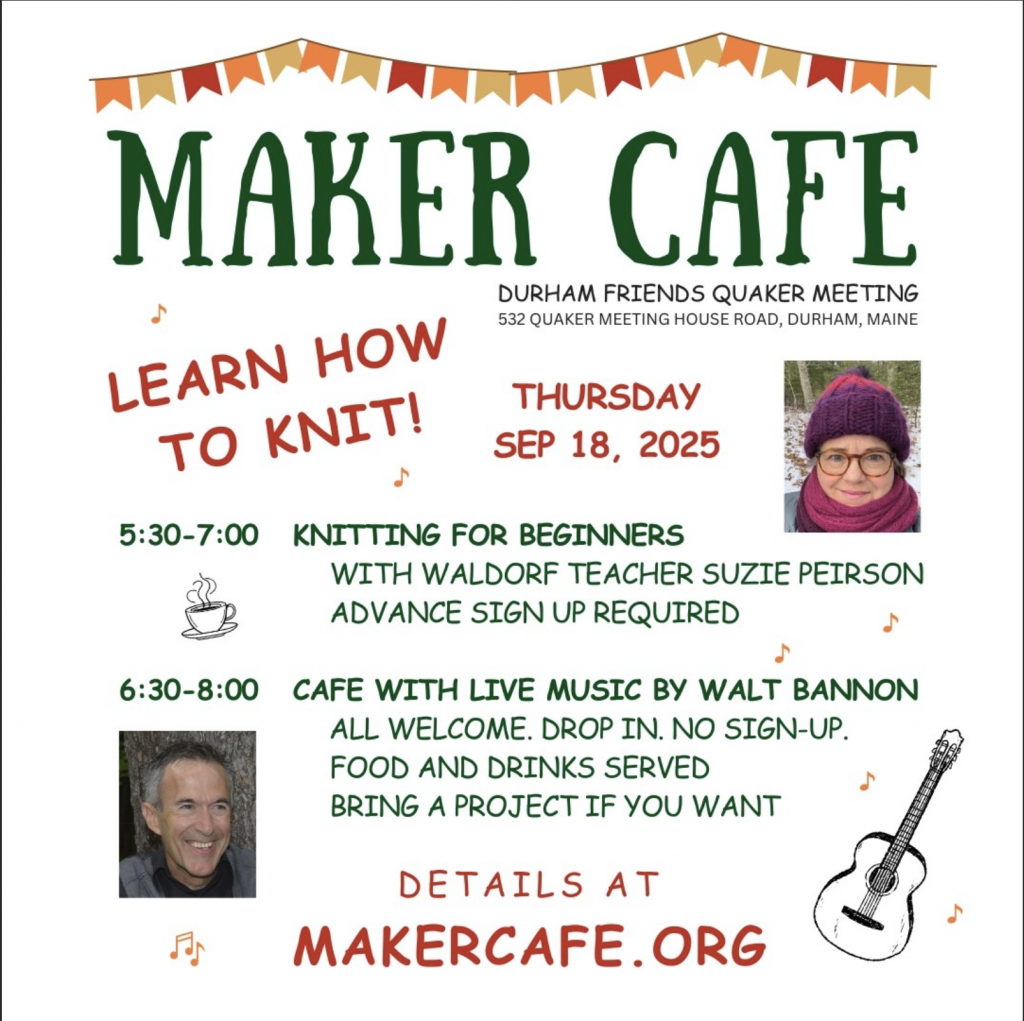
10. Maker Café Update —Kim Bolshaw

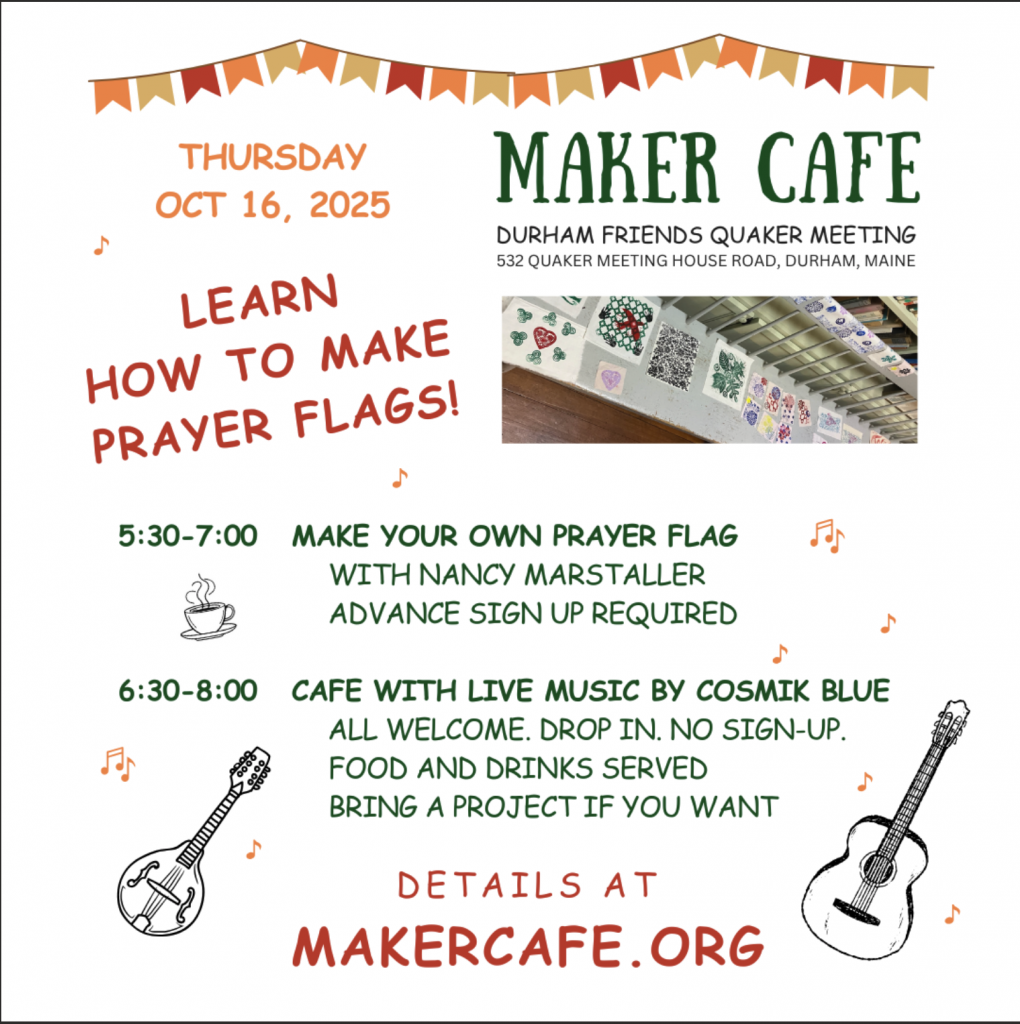
There was a knitting group at the September Makers session with an excellent instructor and 10 knitters. Many non-knitters also came for the conversation, meal and music. About half of those in attendance were not associated with the Meeting. Jenny, who bought the parsonage a few years ago, came for the first time, and also came to meeting for worship today! The music and food were enjoyed by all. Donations covered our expenses with $72 to spare.

11. Meeting Closing

Business Meeting was adjourned with appreciation for everyone’s input and the beautiful fall day.

Respectfully Submitted,

Sarah Sprogell, recording clerk pro-tem.

Attachments:

Request for Assistance to Cuba Yearly Meeting

From Falmouth Quarterly Meeting’s Puente de Amigos Committee

Dear Friends,

In November Cuba Yearly Meeting will celebrate 125 years of Quakers in Cuba.  We are delighted that New England Yearly Meeting General Secretary, Noah Merrill, and Jacqueline Stillwell of Monadnock Meeting have been led and found clear to travel to Cuba to represent New England Yearly Meeting at this week-long celebration. The events run from November 9 to the 16th.  

These plans were made quickly as the concept for this trip came together at NEYM Sessions in August. Due to the short time frame, there has been little time to raise funds to take to Cuba on this trip. The Puente Committee has committed $2,000 to purchase needed supplies and to send cash.  Noah and Jackie could carry an additional $3500 to donate to Cuba Yearly Meeting to use for their many acute needs, especially capital projects to repair churches.  

Please consider donating funds to the Puente de Amigos Committee so that Noah and Jackie can carry the maximum amount of cash allowed.  Whatever you can contribute will be a great help to our Cuban Friends. 

Time is short.  We need to have the funds in hand by Saturday, November 1, in order to convert it to cash in time for their departure.  There are two ways to contribute.  

You can send a check made out to New England Yearly Meeting with Puente in the menu line to our bookkeeper, Roland Stern at 86 Barrett Street, Needham, MA 02492.

Or you can go to this website:  https://www.tfaforms.com/5028973  to use a credit card.  

Thank you for considering this gift. En Fe,

Carolyn Stone and Richard Lindo, Co-clerks of the Puente de Amigos Committee

“Letting Go – My Path to Peace,” by Shelley Randall

Message given at Durham Friends Meeting, September 21, 2025. That same day, Shelley Randall was welcomed into membership at Durham Friends Meeting.

Today, September 21, 2025 and tomorrow September 22, carry a few designations for the world at large and for me personally.

First of all – today has been deemed International Day of Peace by the United Nations. I don’t know where and how that came about but considering the current circumstances the designation seems almost laughable if not for the fact that the state of our world and its beings are in such desperate straits: on-going genocide, starvation, cruel injustice. It is all so very, very sad – almost too much to bear.

And tomorrow is the autumn equinox – a fleeting time of equal light and dark. We blink an eye and the balance, the equilibrium is gone – replaced by fading light into darkness.  That’s what it feels like to me now in the external world as I am bombarded by ever more bad news for our country, other countries and peoples and ourselves as individuals, buffeted about, lost in the chaos of it all.

What I once knew is now uncertain and much of what I took for granted, in fact, is lost. In law school we studied and discussed “due Process rights and the constitutional right of free speech”. Now I wonder what is being taught since both seem to be a thing of the past.  Race based detainment has been upheld by the Supreme Court, at least temporarily.  ? What has become of the apparent guardrails in our democratic system I wail?!

My body, a source of strength and comfort has begun signaling I have lost track of equilibrium as I experience a constant dull achiness and outright sharp pain.

But I know there is good news here – if I begin with me and my body. And the ancient systems I return to when all seems to be lost.

In the 5 Elements theory in Traditional Chinese Medicine each season corresponds to earth elements, body organs and functions, emotions, foods, colors, sounds and more. The premise is the interconnectedness of all.

The Fall time corresponds to the element of metal, once used to forge tools to cut and slice away. Hatchets, swords, knives. These metal tools can be seen as a metaphor to cut away from my life that which no longer serves my best interests. Relationships, habits, foods, etc. When the cutting away occurs, we naturally feel a sense of loss and sadness, these emotions correspond to the Autumn and metal season. I like to think about the maple trees letting go of their leaves as they prepare for winter time, the most yin, quiet time of the year. The trees cannot sustain their leaves as their energy and nourishment fades.  So they let go and say good-bye, at least temporarily. And we mourn our losses of what once was. The long warm summer days that allowed us to spend hours outside. And we mourn the losses, even those habits that we give up because we must.  I taught Qi Gong at a 28 day residential program for addiction treatment and I used to talk about mourning the loss of our relationship to our addictions. Though in our best interest to let go of this relationship there must be a period of mourning and reflection around how they served us and why we need to say good bye. And what will take its place. And what can we develop to fill that place where drugs and alcohol once resided?

The saying good-bye part, the mourning and reflection is always the most painful. We have to look at how we got to that point squarely in the eye, being brave, feeling the agitation, sadness, the rage and the fear.

And I come face to face with my Self when I go through this process. This time around, my body was screaming at me, and I needed a professional to tell me – this pain is an issue of lack of mobility. And I was mad. At me, at my body. Why can’t I just relax now that I’m older, why can’t my body do what I want it to do without the extra time and effort to stretch and build strength. How did I forget that this practice needs to be part of my life?

And most importantly, Who am I now that I am older? What can I do and not do as a result? What are my limitations? And Who do I want to be going forward.

I am also cognizant that I am a person that feels deeply and the state of our country and the world affects me as it affects all of us deeply. How do we manage the sharp and overwhelming emotions that arise daily as we are bombarded with what seems to be more and more bad news, as we perceive that our country and our world as we know it is falling apart and what is our role now.

I come back to the premise of mourning. I know now that I must cry everyday in order to expel the grief that I experience every day, as I let go of what I thought were givens about how our government was supposed to operate and conduct itself. I can no longer hold onto the premises that I grew up with, that were instilled in me as a child. This is what is so shocking and so disturbing, along with what we know could happen if the guardrails in a democracy are completely destroyed. This potential is terrifying.

In the book Our Life is Love, The Quaker Spiritual Journey written by Marcelle Martin, she writes about Bill Tabor, “ a longtime teacher of Quakerism at Pendle Hill” and the pamphlet he wrote called Four Doors to Meeting for Worship. In it he recommends taking a period of “daily retirement” from the outward activity and business of one’s life. During such a period, Friends can contemplate a passage of the Bible, rest silently “in the eternal arms”, meditate, appreciate beauty, or pray for themselves and others.” (pgs. 147-148, Our Life is Love).

It is carving out time for this that creates the struggle in me. Is this enough for me to do? Shouldn’t I be doing more? The country is exploding in violence and I need to contemplate beauty? I ask myself. And then my body slaps me upside the head with that pain reminding me that I must take care of myself, first and foremost. I must give myself the time to mourn the devastating losses I am witness to. I must be in right relation with God. Only then can I be of service.

And this is a huge letting go for me. I was once a warrior, armored up, not needing anything but conviction and a facility with language to defend the violated and the oppressed.

But I am no longer that person. I have morphed, evolved into something else, something softer and more approachable. A body now with a heart that is open and strong and willing and filled with God’s love. A whole being that cares deeply. About myself as God’s child and about God’s other children and Mother earth and all her beings. And how can I maintain my equilibrium in order to be of service to this world that seems to be exploding around me. How can I utilize my skills and keep myself safe.

In Our Life is Love, Marcelle Martin writes about our Quaker forebears that sacrificed their lives for us to worship as Quakers. I applaud their heroics and am grateful that they led the way for me to stand in front of you today.  And each of their stories demonstrate a knowing that God was with them up until the end and they were calm.

So as I let go of the warrior I once was and fill that space with quietude to connect with God’s beauty. I can fill my heart with God’s loving strength and know that I am led and will always be led to where I am most needed. And I know also, that because I am filled with God’s strength and courage if I am called to do more than what I am doing now, I will show up. But in the meantime I must respect what God has put in front of me to do and continue my daily practices of respite.

This knowing and trusting that God will show me the way when I remember, alleviates the fear and the anxiety when my ego screams at me that I am not doing enough. This knowing and trusting comes from the “daily retirement” that Bill Tabor speaks of that provides me with strength to move forward just as I am.

So I let go of the hard wiring for action that has so defined me. And I mourn this loss and mourn the losses and suffering currently being experienced by so many humans, animals and ecosystems on the planet and I wait for the way to be opened.

And I’m painfully aware that a “daily retirement” is a luxury provided to me. I am not starving to death, or in the midst of a civil war or getting bombed out of my home and country. And again, what do I make of this? What is my responsibility in this midst. How can I contribute to Peace nationally and internationally on this International Peace day.

I try to return to my body and my heart. Am I at peace with myself? If not, how can I get there? Usually I need to recognize a resentment about someone or something, or a fear about something or someone – neither of the someones or situations I can control, so it has to be an internal shift towards understanding and compassion towards the someone or situation.

This is internal shift towards Mercy, a seemingly “old fashioned” word or biblical term has been lodged in my brain of late. The dictionary definition of “mercy” is Compassion or forgiveness shown towards someone whom it is in one’s power to punish or harm.

Mercy. The Spanish name Mercedes references Mercy. Girls in the U.S. were also once named Mercy. This a reminder that Mercy was not only found in our daily vernacular of old but also it was a name attributed to girls and women.

So when I hang on to a desire to punish myself or others, perhaps I can conjure the word “Mercy”. Mercy with a capitol “M”. Because as I know and have experienced, hanging on to the anger and the desire to harm can create its own discomfort in my body, my mind and in my heart.

The lack of mercy propelled me in my job as a warrior. The urge to punish those that I believed had oppressed another or were being unfair or who did actual harm. As a Child Protection Lawyer, I could understand and have mercy for the parents who harmed their children knowing that they had been harmed by their parents and the harm followed generations. What I held onto was the anger and desire to punish those in power who were oppressing vulnerable populations. This desire to punish was borne from my own sense of powerlessness operating within a skewed and unjust system.

It was my the lack of mercy by the government that is what I could not get past. And I suffered for it. I was a body charged and crackling, emanating anger and resentment and people were afraid of my energy and punished me. Ultimately, I was ejected from the very system that I was convinced I could help and contribute to. It was this urge to punish and hurt in the face of injustice that I had to let go of, it was eating me up, diminishing me and isolating me.

I realized I had not done the internal work necessary to find that place of balance to work towards justice without succumbing to the urge to punish and do harm. I had to find another way which required removing myself from the situation – of course, the system gave me a little nudge – and diving into the inner recesses of my being to uncover what – I did not know.

And as I’ve delved deeply internally, with God’s help, I’ve come face to face with two things: the infinite power that is Love and my own finite limitations. So it is here that I rest in a state of readiness to heed God’s call. It is here that I retire daily to connect with whatever God’s message and direction is for me. This trusting is a daily practice and this daily practice brings me to a sense of peace and rightness with the world that I can share with others. And that is enough. Right now, that is what God is calling me to do. There is peace in the sense of enoughness.

And now that I have let go of the should and mourned the loss of my old ways of being and make sure to take my daily retirement, I can go out into the world and carry peace with me to others, knowing it is enough and praying my favorite peace prayer.

Peace, peace, peace.

May I have peace in my heart,

Peace in my speech and

Peace in my mind.

May all beings know peace, as I wish to know peace.

                                                      Author unknown

Friends Committee on Maine Public Policy, October 16, 2025, 4-6 pm

From Shirley Hager, regarding the Friends Committee on Maine Public Policy (FCMPP):

Please save Thursday, October 16, 4:00-6:00 p.m. for a fall FCMPP meeting on Zoom.

Maulian Dana Bryant, Executive Director of the Wabanaki Alliance, will be our guest to share highlights of what the Alliance would like to achieve in the upcoming legislative session, and also to talk about the importance of Question #1, on the ballot this November, for Wabanaki communities and for all of us. This is an opportunity to get revved up and focused on upcoming important issues, and to have your questions answered.

Members of the Episcopal Committee on Indian Relations are invited as well.  I have included several of them in this email and invite them to spread the word on their committee.

Stay tuned for further details of the meeting, and for the Zoom link, a bit closer to October 16.

Best wishes to all amidst this beautiful fall weather.

Shirley — Shirley N. Hager

https://www.thegatheringsbook.com; And now an audiobook! https://utorontopress.com/utp-audio/ (click on book image)

Please include a request for anyone wanting to join us who are not on the FCMPP list to email me at: shirley.hager@maine.edu, so that I can send them the Zoom link and meeting details closer to the meeting date.

“Thoughts on the Spiritual Journey,” by Joyce Gibson

This meditation was Joyce Gibson’s opening reflection at Durham Friends Meeting on August 31, 2025

Thoughts on The Spiritual Journey

On the drive from Massachusetts this morning, my thoughts turned to my work with my first spiritual advisor Dr. Margaret Benefiel, now head of Shalem Institute, who taught me how to stop and discern how God was leading me; in the middle of our hourly sessions, which were focused on my efforts to stay on the path of my spiritual journey, she would ask that we take a few minutes to be silent for guidance.  Figuring out what God would want from me in the everydayness of my life was new to me then. Being present with Him at any time of day was also what I was not doing, or practicing!    I now make an effort to be present to God, yet it is ever the struggle.

Today I would like to introduce two of my special people, Father Thomas Keating, known as the Father of Contemplative Prayer, someone I actually experienced in one of his presentations in Boston, and Father Richard Rhor, a Jesuit who founded the Center for Action and Contemplation, (CAC) based in Albuquerque, New Mexico, and whose work I follow in daily meditations and through his books. meditations@cac.org

This excerpt is from a lecture Father Keating was invited to give as part of the 1997 lecture at Harvard Divinity School– the Harold M. Wit Lecture on Living a Spiritual Life in the Contemporary Age, and was published by St. Benedict’s Monastery in Snowmass, Colorado in 1999. The book is The Human Condition: Contemplation and Transformation. Father Keating was the former Abbot of the Trappist Monastery in Spencer, MA, and one of the foremost teachers of contemplative prayer in the Christian world.  He begins his lecture with a question, “Where are you?”

The spiritual journey, writes Thomas Keating, is not a career or a success story.  It is a series of humiliations of the false self that becomes more and more profound.  These make room inside us for the Holy Spirit to come in and heal.  What prevents us from being available to God is gradually evacuated.  We keep getting closer and closer to our center.  Every now and then God lifts a corner of the veil and enters into our awareness through various channels, as if to say, ‘Here I am.  Where are you?  Come and join me.‘(back cover, 1999)

Today’s meditation from Richard Rohr, Choosing to Become Present, connects quite well with Father Keating’s message in his lecture.  

He writes:

Anyone familiar with my writing knows that I believe that immediate, unmediated contact with the moment is the clearest path to divine union.  Naked, undefended, and nondual presence has the best chance of encountering Real Presence.  I approach the theme of contemplation in a hundred ways, because I know most of us have one hundred levels of resistance, denial, or avoidance….

In my novitiate I was exposed to an early method of silent Franciscan contemplation called pinsar sin pensar or no penar nada as described by the Spanish friar Francisco de Osuna.  I didn’t totally understand what I was supposed to be doing in that silence of “thinking without thinking” and probably fell asleep on more than one occasion.  Yet it had the effect of moving me away from the verbal, social, and petitionary prayers I had been taught almost exclusively up to that time.

Prayer is indeed the way to make contact with God/Ultimate Reality, but it is not an attempt to change God’s mind about us or about events.  It’s primarily about changing our mind so that things like infinity, mystery, and forgiveness can resound within us. (Richard Rohr’s Daily Meditations, Week Thirty-Six:  Practicing the Presence, Sunday, August 31, 2025)

As we move into waiting worship, consider, “Where are you?”

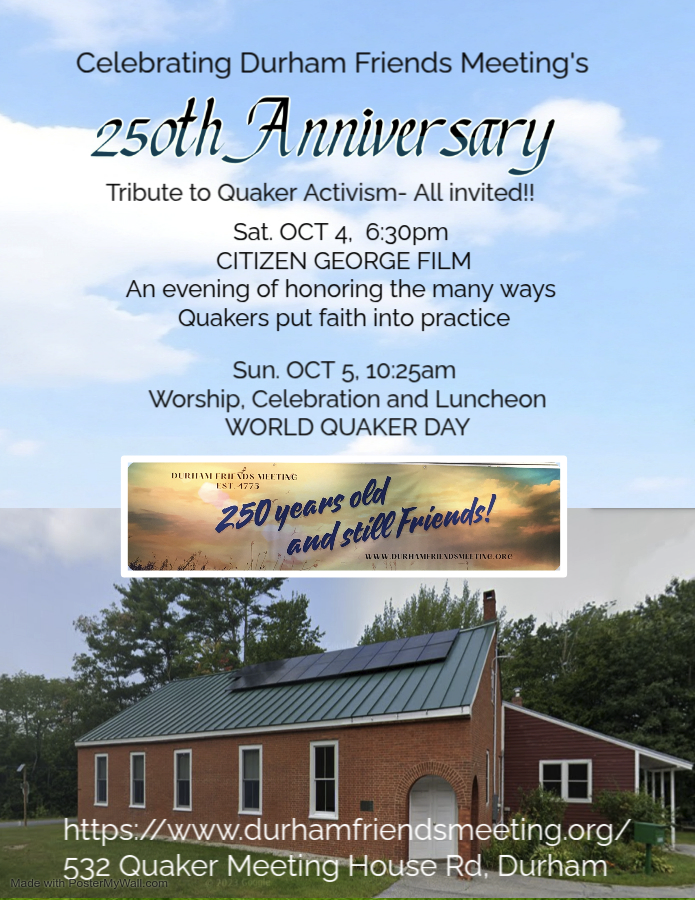
250th Anniversary Celebration – October 4 and 5, 2025

Our Meeting is celebrating its 250th year as a worshiping community on the weekend of October 4 and 5.  

Saturday (October 4) will feature a Tribute to Quaker Activism, featuring the film “Citizen George” which presents the life and work of Philadelphia-based contemporary Quaker activist George Lakey, a nonviolent revolutionary who has worked his entire life for justice and peace, guided by his ideal of societal transformation, with community singing to open our time beginning at 6:30 PM.

Sunday (October 5), which is also World Quaker Day, will open with worship at our usual time of 10:25 AM and will also be available on Zoom. Our prepared message will be given by Doug Bennett, a member of Durham Friends and President Emeritus of Earlham College, a Quaker institution in Richmond, IN. This will be followed by a luncheon and celebration (and possibly more singing).

All are welcome to any and all of this celebration. Instructions for attending Sunday Worship via Zoom are available from our website durhamfriendsmeeting.org

For questions or more information, please contact durham@neym.org.

NEYM Youth Retreats

We’ve received the following letter from New England Yearly Meeting regarding Youth Retreats.

Back to school greetings to you! As Yearly Meeting youth program staff we write to you today in hopes you can help ensure that as many Friends as possible know about our Quaker youth retreats.  Could you share this message with Friends in your meeting?

New England Quakers have been blessed with spiritually robust, well attended, and much-loved year-round youth programs. Among our most cherished ministries, our weekend youth retreats offer a meaningful opportunity for Quaker youth to connect with peers, experience loving community, and grow in their faith. Our retreats are fun, centering, playful, grounded, youth-centered spaces for Quaker and Quaker-curious youth.

Are there families or individuals in your meeting who might be interested but don’t know about retreats (or don’t know where to find the details)? If so, the best way to stay in the loop about youth retreats is to subscribe to receive updates for the age group(s) of interest at https://neym.org/newsletter-signupYou can also read basic information about retreats on our website here.

Attached is an electronic version of postcards with the retreat calendar and information about our programs for elementary, middle, and high school youth (Junior Yearly Meeting, Junior High Yearly Meeting, and Young Friends). If you would like physical copies mailed to your meetinghouse for distribution email Kara Price (kara@neym.org). These postcards will be sent directly to families who already participate in our retreats.

Thank you for reading, spreading the word, and helping to make the upcoming retreat year a wonderful one.

Warmly,

Xinef Afriam, Teen & Outreach Ministries Coordinator (Xinef@neym.org)

Kara Price, Children & Family Ministries Coordinator (Kara@neym.org)

Nia Thomas, Program Director (Nia@neym.org)

“The Experience of Interdependence,” by Lisa Steele-Maley

Message given at Durham Friends Meeting, August 15, 2025, by Lisa Steele-Maley 

Each summer, I noodle over the idea ~ and the experience ~ of Interdependence

I know this is spurred on by a desire to create counterbalance to the annual celebration of independence every July and I suspect it is sustained by watching the plants and insects of the garden interact with each other and the waxing and waning of sun, rain, and wind. 

I, perhaps like many of you, was raised in a family and culture that values independence. As I have grown older, I have seen how the idea of independence creates a separation that contributes to environmental and human exploitation, consumerism, competition, overwork, and dominion over creation rather than responsibility to it. 

The ideal of independence also keeps us from asking for help, leaning on friends, and fostering community, no doubt helping to create the epidemic of loneliness. 

To be fair, Independence does have its place – it allowed this country to originally become independent from the greed and control of a ruler king. It allows children to grow up and into their own lives. Because we are independent, we make up our own minds on matters of moral and ethical consequence. We love. We dream. We create. We can, in fact, choose to live our way toward a more whole, just, and loving world. 

But independence also creates a scar. You have heard of the idea of original sin? I think of separation as our original wound… and many of the wounds we experience in our lives and inflict on others stem from that original hurt. 

Interdependence is our true nature. Our brief lives on this Earth are truly interwoven, intermingled, and interconnected with all other beings throughout time and space…. 

We can not actually be independent of each other. We are wholly interdependent on each other, on the Earth that sustains us, and on a holy living truth that is greater than ourselves. Whether they name this unifying divinity God, Buddha Mind, Universal spirit, Brahman, Pachamama, or Holy Mystery, most traditions point to a sacred that is both immanent (within us) and transcendent (all around us). 

It is this holy weaving ~ around, within, above, below, and between that assures and reminds me that we inter-are. 

Inter-are comes from the word inter-being, coined by the buddhist monk, Thich Nhat Hanh. He says “ I was looking for an English word to describe our deep interconnection with everything else. I liked the word “togetherness,” but I finally came up with the word “interbeing.” The verb “to be” can be misleading, because we cannot be by ourselves, alone. “To be” is always to “inter-be.” If we combine the prefix “inter” with the verb “to be,” we have a new verb, “inter-be.” To inter-be and the action of interbeing reflects reality more accurately. We inter-are with one another and with all life.” This concept of interbeing really gives our American minds, bred on independence, something to chew on.

It is in letting this concept integrate into my body and heart that I can really live into it, creating a counterpoint for my mind that can get stuck in habitual loops that reinforce the myth of separation. 

In our bodies, we have no choice but to know that we inter-are. After all, we require air every minute, water and food each day. The living, breathing world quite literally sustains us. 

We breathe in because our bodies require oxygen. We breathe out carbon dioxide. Trees take in the carbon dioxide that we exhale and release oxygen. We are co-breathing with trees all of the time. This is perhaps the simplest and most profound example of interdependence that I both know and also pay little attention to most of the time. 

But paying attention to the many ways that I am in fact connected to All That Is has been particularly helpful this summer amidst the fullness and frantic pace of the news cycle that keeps my lizard brain on high alert. 

Paying attention with my whole body, letting my senses inform and bless me re-members me to my true belonging to this living world. I don’t need to do anything to be worthy of it. It is simply already true. 

I’ve had the opportunity to swim a bit this summer. Every time I get in the water, I lay back and float for a while, feeling the water hold and suspend me while the sun warms my face. It’s been really nourishing to remind myself that I am always this supported. 

During a humid morning a few weeks ago, I was startled by the intoxicating dream-like fragrance of the blooming milkweed. I smelled it before I saw it. As I drank in the smell, I noted that the flowers are offering themselves to the pollinators of the insect world and I am an adjacent beneficiary. Later that day, when I noticed the monarch butterflies fluttering from stalk to stalk, my body recalled the morning’s fragrance. I could actually feel the butterfly’s attraction to the flowers as an expansion in my own heart. 

I said a minute ago that I don’t have to do anything to be fully integrated in the web of connection. That is true, and it is also true that I can actively work to tend and weave the web of connectivity with my actions and sacred imagination. 

When I introduce one friend to another, I am weaving a web of connection by bringing together two people whose lives may be enriched by knowing each other. When I usher a fly out of my house instead of swatting at it, I am supporting and enhancing the life of another being. When Leslie broke her ankle and put out a call for help, she was building new strands of connection. When I responded to her invitation, I reinforced the integrity of the web. We are co-weaving with one another. 

We are, in fact, always giving and always receiving. As I attune to interbeing in this season, I recognize reciprocity everywhere. As Robin wall Kimmerer says, “All Flourishing is Mutual” 

A few nights ago, the night was humid when I laid down for sleep. The window beside the bed was open but the air felt still and the night sky was silent. It was calm. Peaceful. Yet, as I lay there, a thought intruded, “this is the kind of night that bombs are dropped on.” 

I brought my hand to my suddenly racing heart. (Studies have shown that this simple touch activates the vagus nerve which plays a role in regulating the nervous system.) My thoughts went to far away lands – to Gaza, Ukraine, Yemen, and Iran – and it felt abundantly clear that the safety that I was enjoying in that moment was not guaranteed. It does not have to be this way and it can change in a heartbeat. 

Laying in bed with my hand over my heart, I let my sacred imagination weave a connection to another mother in another land, a mother laying in bed with fear in her heart, and hunger in her belly as the night sky rang with the sounds of destruction. 

I prayed with her for peace, for the safety of her children, for space to grieve the immense losses that she has already suffered. I prayed that she might wake to a quiet sky and a table graced with fruit and bread to nourish her family. I prayed that the planet will recover from the devastating pollution and destruction of war. I prayed that humanity will someday heal from this violent separation that is created by distinguishing “us” and “them”. As I drifted from prayer toward sleep, I felt a touch of peace born of connection and faith. 

In just a few minutes, laying in bed, I moved from isolation and desolation to profound connection and peace. It is all so much bigger than I can know. 

I’d like to close with the words of Joanna Macy, a brilliant thinker and activist who developed the Work that Reconnects. She died on July 19 of this year at the age of 96. 

Trusting the Spiral 
Active Hope is not wishful thinking. 
Active hope is not waiting to be rescued 
By the Lone Ranger or by some savior. 
Active Hope is waking up to the beauty of life 
On whose behalf we can act. 
We belong to this world. 
The web of life is calling us forth at this time. 
We’ve come a long way and are here to play our part. 
With Active Hope, we realize that there are adventures in store, 
Strengths to discover, and comrades to link arms with. 
Active hope is a readiness to discover the strengths 
In ourselves and in others; 
A readiness to discover the reasons for hope 
And the occasions for love. 
A readiness to discover the size and strength of our hearts, 
Our quickness of mind, our steadiness of purpose, 
Our own authority, our love for life, 
The liveliness of our curiosity, 
The unsuspected deep well of patience and diligence, 
The keenness of our senses, and our capacity to lead. 
None of these can be discovered in an armchair or without risk. 

– excerpted from Active Hope by Joanna Macy and Chris Johnstone

“Living in the Life and Power,” By Noah Bishop Merrill (Putney Meeting)

Message given as New England Yearly Meeting Secretary at NEYM Annual Sessions, August 2, 2025

I want to speak about convincement, about becoming implicated in each other’s faithfulness, and about our Testimony. I want to speak about living in the Life and Power. Some of what I share may be difficult to hear, but these are difficult times. I trust with all my heart that we are eternally held, and pray that our Guide will help us hear whatever we need to hear. 

Almost 20 years ago now, I spent five years of my life engaged in a ministry of humanitarian aid, advocacy, and peace activism in support of people internally displaced or made refugees as a result of the United States’ invasion of Iraq in 2003, its precursors, and its devastating aftermath.

In those years, I encountered daily, with visceral intensity, the evidence of what the weapons of war do to human families, to the human body, to human hearts and souls. Working alongside a group of Iraqi, Palestinian, and American activists, we sought to partner with efforts to find vitally needed support for people in need of significant and often lifesaving medical care. 

When not in the Middle East and West Asia, through the support of several US-based organizations, I had the opportunity to travel across the United States, telling stories, with permission, that some of the people I had worked with had trusted me to share. They were stories of profound suffering, abandonment, shattered hopes, broken lives. Stories that would defy comprehension, if they weren’t true. 

They remain with me still, etched in memory. A man my age paralyzed by a fall from his roof caused by the concussive impact of bombs falling on his neighborhood. A young woman learning to live with unremovable shrapnel in her body, the only survivor of a missile’s destruction of her whole house and family, including her baby daughter. A 6-year-old boy burned from head to toe by an explosion caused by a U.S. Marine raid on the camp where he and his family had taken shelter from sectarian violence. A woman’s face burned by acid, part of attacks by sectarian militias who had been armed and empowered by the U.S. occupation forces. Their trust in me, and their yearning for their stories to be shared with a world seemingly or willfully oblivious to the hell they were living, spurred me on. 

In those days, I was mostly fueled by anger. It drove me. I remember how it felt to bear witness, face to face, to the stories and the experiences like these I have just shared. The weight of that burden. Maybe some of you have felt a burden like that, in your own context. Perhaps some of you are feeling that kind of burden here and now.

Sometimes, the only relief that I could feel was when I was speaking to a group of people in the United States, and I realized that the pain that I had shared had brought tears. Knowing that I had disturbed people’s hearts, that they had felt in some small way the pain of those whose stories I carried, that I had made them hurt. Anger is an insufficient word for how I lived my days. So is guilt. So is obsession. 

In 2008, I was in Syria, in a neighborhood that was later reduced to rubble in the Syrian civil war to come. 

I’ll always remember the words. “He wants to meet you.” For weeks, we had been hearing stories about a man who had suffered profoundly, unspeakably. People said we should speak with him, but his location was a secret, out of fear of retribution given what he had been through; Syria was an uneasy refuge for those fleeing violence and chaos in Iraq in those days. 

But now we had been approached with an invitation. To meet with this man, to drink tea, and to hear his story. One of the man’s companions led us to the place, through the winding streets of the Old City of Damascus. 

The man was seated and waiting for us. After the tea was poured, he began to tell his story.

He was an Iraqi Christian, he said, part of one of the oldest Christian communities in the world. His ancestors had lived in Iraq for centuries, largely peacefully with their neighbors of all faiths.

But when the war came, and the chaos followed it, ethnic and religious minorities began to be increasingly targeted by rival sectarian militias, groups intent on creating polarization, mutual distrust and division, and fear, leading to ethnic cleansing.

He told me how a gang of men with their faces covered with black masks dragged him from his bed into the street. They took him to the basement of a now-empty house somewhere he didn’t recognize. And there, in that cellar, they tortured him. Not for any action he had taken, but simply because of his religious identity, and to serve as a warning to others. And then, in sacrilegious mockery of his most deeply held faith, they ended that night of horror by hanging him on the basement wall. They crucified him. And they left him to die.

With whatever partial consciousness he had remaining, he prayed. He prayed that God would free him from this suffering, even if it meant helping the end come soon so that he wouldn’t have to endure the pain and humiliation any longer. He prayed that Jesus would save him from the evil that had been unleashed among his neighbors and in his country, that Jesus would save his country.

It was then, he said, that the miracle happened. He said that he saw an image of Christ, bearing the same wounds he bore, coming toward him amidst the shadows and desperation. But, he said—and this he said was important—this Presence didn’t take away his suffering. The One he experienced as Christ didn’t take him down from where his broken body was hanging.

Instead, as he described his experience, the Presence of the Living Christ joined him in his darkness and desperation, climbing up to accompany him where he was hanging on the wall to share with him completely in his suffering and misery and grief and yearning for justice. And in that moment—though time seemed to fade away—he told me that he felt an all-embracing sense of peace, an overflowing of a profound joy. And then, everything went dark.

When he awoke, he realized that he had been thrown in a vast garbage heap, left for dead. And somehow, through step by grace-filled step, he was given the strength to escape the neighborhood, the city, the country. With help from Muslim friends, he crossed the border into Syria, was found again by caring people there, and offered this place to live, and to heal. 

As he finished his story, my hands were shaking—with rage, despair, and powerlessness. It was as if all the burdens that I had been carrying in those years, all of the horror and the anguish of the evil of which we are capable as humans broke like a dam in my head and heart. I was unable to speak, maybe even to think. For a long time, I couldn’t lift my head to reach his eyes. 

And then he spoke again: “Wait, my friend. This is why I wanted to meet you. This is what I wanted to tell you, this is what I believe you need to know, and what I want you to share—Did you hear that He came? And do you see that I am Alive?” His eyes, I now saw, were shining. And his face was radiant with light and joy.      

In that moment, I suddenly understood that he had called me there not for him, but for me, and all whose hearts might be opened by his testimony. The story he had called me there to hear was not—at its heart—the story of an encounter with evil, but of an encounter with the power of being met by the peace that the world cannot give, and brought home into the transforming power of God. It was a story of Life triumphing over death, a narrative outpost in enemy-occupied territory, a breaking in of divine Love restoring human dignity and personhood in a parched wasteland of despair. And this was the story to which he had called me to bear witness—through sharing this experience in his life, and, if I chose it, in my own living as well. 

Friends speak about moments of conviction in our spiritual lives, when we come to see the condition of our hearts and souls with a clarity and starkness that offers an almost irresistible invitation—even a crying need—to change and grow. This encounter was such a moment for me. 

I came to see that, in my quest for justice, and even in my yearning and advocacy and organizing for peace, I had so often been bearing witness not to the Life and Power, but to the power of anguish, tragedy, terror, and evil. I had been preaching what could be called a “gospel” of despair. There was no “good news,” only more anger, more struggle, more relentless fighting to assuage my conscience and keep the nightmares at bay. And in this way of living, there was no invitation to another kind of Life. I was sunk down in the ocean of darkness and death; the ocean of Light and Love seemed like a fantasy.  

I realized then, with a shudder that swept my whole body, that I was in the tendering presence of a human being who had come to live in the Life and Power. And in this encounter, the cords that bound about my heart began to loosen. The burden I had been carrying, and the way I believed I had to carry it—with anger, desperation, and the need to control, to fix and save—began to change. And in the breaking of my heart, a living stream of joy began to flow—slowly at first, then growing, as I attended to it, to be of service in ministry. It had been there all the time, waiting. And in the many years since, while I have often been distracted, denied it, dishonored it, or suppressed it, I know that it has never stopped flowing. 

“Living in the Life and Power.”  George Fox, one of the founders of the Religious Society of Friends, used these words to describe his experience of the inward reshaping of his heart that made him unable to engage with outward weapons in the warfare and social turmoil so rampant in the bloody times in which he lived, and in which the Quaker movement was born. 

Reflecting on a meeting with recruiters for one of the armies who claimed that they were fighting for justice, liberation, and the Kingdom of God, who had seen his gifts of leadership and were seeking to give him a military commission to command soldiers in battle, he wrote in his journal,

I told them that I lived in the virtue of that Life and Power that takes away the occasion of all wars and strife … I told them that I had come into the covenant of peace, which was before all wars and strivings were.

This testimony to a direct experience of the Spirit at work in a life, and in the lives of those around that person, has been at the heart of what Friends have called “testimony”—the ways in which the liberation and repatterning of our hearts, and the actions arising and patterned by that freedom and joy, bear witness to the Truth, as Friends have used that word, to describe not a set of principles or list of rules or a catchy acronym, but a relationship—that is, a relationship and journey with the Spirit, present and active, at work in our world, within, among, and through all whose hearts are willing. 

We can help remind each other, when we inevitably forget or get distracted or confused or frustrated. Our meetings’ rhythms of common life are intended for that purpose. In our own Faith & Practice, that trusted handbook on this pilgrimage together, the query for the twelfth month that is read in many of our local meetings for worship, including my own in Vermont, reads:

“Do you live in the virtue of that Life and Power that takes away the occasion of all wars? …when discouraged, do you remember that Jesus said, “Peace is my parting gift to you, my own peace, such as the world cannot give. Set your troubled hearts at rest, and banish your fears.” – John 14:27 (from F&P 1985, pg. 147)

Queries such as this are designed to help us reflect as a worshipping community on what is most essential in our living tradition, and how it shapes our living. Because this is the essential part: Friends have found that this seeking, this abiding, this growing and testing and acting in the Spirit, is a pilgrimage on which we need accompaniment. Some of us are given frequent or overwhelming experiences of this spiritual reality, others only glimpses. For some of us, our experience has yet to reflect the words we hear about worship, about leading, about living in relationship with this tender, unshakeable, and infinite Love Who seeks us. And that is why we need each other. As my friend in Syria was for me in that moment of conviction, we are called to present to one another, to help unbind each other’s hearts. 

I have spoken about joy, and I want to take care not to be understood to glorify suffering or urge passivity, or to suggest that mere “happiness” is an antidote or a thin bandage that we should cultivate to cover over the very present manifestations of humans’ capacity for evil—in these times, or in any. These platitudes are the story our society is selling all around us. I am speaking about something different when I speak about this kind of joy. 

New England Friend and minister Elise Boulding gives words to this difference with clarity and power:

For the real difference between happiness and joy is that one is grounded in this world, the other in eternity. Happiness cannot encompass suffering and evil. Joy can. Happiness depends on the present. Joy leaps into the future and triumphantly creates a new present out of it. It is a fruit of the spirit, a gift of God—no one can own it … Joy is the ultimate liberation of the human spirit. It enables the human being to travel to the very gates of heaven and to the depths of hell, and never cease rejoicing.

These are times of terror, of scattering, of collapse, when evil masquerades as truth, and despair is crouching at the threshold. When corruption seems ascendant, and mercy is outlawed by human authorities. Yet they are also times of healing, of remembering, of new vision, of weaving and reweaving the threads of covenant community in ways more resilient, more authentic, more willing to invite and share our testimony to the Life and Power in which we have covenanted to travel on this adventure of faith. 

The Religious Society of Friends, our local meetings, were never meant to be places for the welcoming, respectful practice of hyper-individualism. The discovery and nurture of these fellowships, centered in worship, was always intended to help Friends gather and be gathered by the Spirit into local covenant communities—anchored and shaped in worship, nourished in fellowship and mutual care, formed in exploration of our living tradition, and sent forth by the overflowing of Love in our hearts into service and love of neighbor in the whole of our lives. And all of this, all these fruits of this journey together, however imperfect, are our Testimony. 

But there is one thing needful. We must not allow ourselves to fall into despair of the living water, even in this parched wilderness. It is the witness of countless generations, who like us suffered and struggled and mourned and rejoiced and lived and died in faith, that the Life and Power we seek is closer than breath to us, always seeking new channels through which Love might continue to come into the world.

There is a fragment of a poem, a gift from Denise Levertov that has become a prayer to me—and a vow—one that speaks to me in the deserts of my soul; I hope it might speak to us:

Don’t say that there is no water
to solace the dryness at our hearts
It is still there and always there
with its quiet song and strange power to spring in us
up and out through the rock.
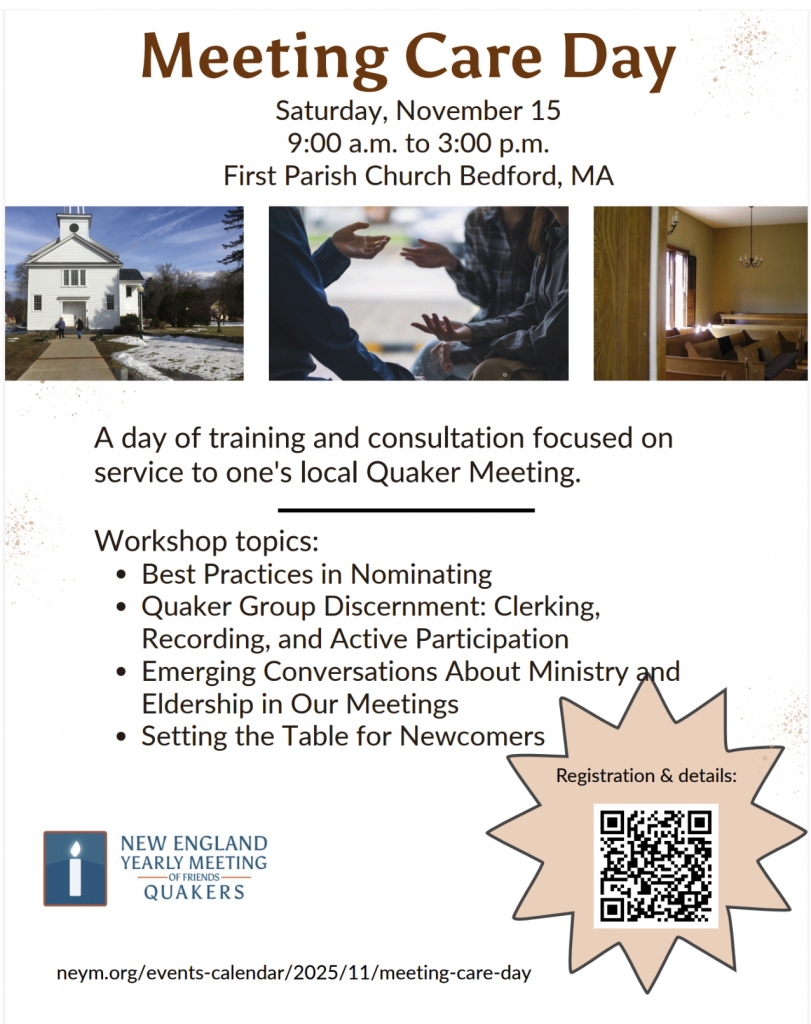
                         

Durham Friends Meeting Minutes, July 20, 2025

Durham Monthly Meeting of Friends Minutes, July 20, 2025

Ellen Bennett — Recording Clerk

Durham Monthly Meeting of Friends met for the conduct of business on Sunday, June 15, 2025, with thirteen people in attendance at the Meetinghouse and two by Zoom.

1. Meeting Opening

Clerk, Renee Cote, opened the meeting with a quote that begins John Punchon’s Portrait in Grey. It is the fourth verse from the poem The Brewing of Soma, by John Greenleaf Whittier:

Drop Thy still dew of quietness

Till all our strivings cease;

Take from our souls the strain and stress,

And let our ordered lives confess

The beauty of Thy peace.

[This is also the fourth stanza of the hymn “Dear Lord and Father of Mankind”.]

2. Approval of Minutes of June 2025

In item number seven of the June minutes, “Puente de Amigos” is the organization cited that could help with Kirenia’s travel.

3. Approval for suspension of Monthly Meeting for Business in August — Renee Coté

4. Ministry and Counsel Report —Renee Coté

Supporting Juno Kay in her need for medical care. (Please see report for greater details.)

The Clerks group approved sending monetary support to Juno from the Charity account on an expedited timeline.

Clerk read the certificate of transfer from Narramissic Valley Monthly Meeting regarding Margaret De Rivera’s transfer of membership. The certificate included words of praise for her three decades of membership there and her good works on behalf of the community and Quakerism. Durham Monthly Meeting will send an acknowledgement.

The Clearness Committee assembled for Shelley Randall recommends that she be admitted to membership. In honor of her membership, Shelley will receive New England Yearly Meeting’s Faith and Practice.

5. Peace & Social Concerns — Ingrid Chalufour

An article describing the Social Justice Book Project has been submitted as a feature article for the winter issue of Friends Journal.

There was a brief report about the planned event on October 4th, preceding World Quaker Day on October 5th — a tribute to Quaker activism, including the 99 minute film “Citizen George” about George Lakey. A list of Quaker activists, known to the Meeting, who have made significant contributions to Quakerism, their communities, and the world, is being assembled for recognition on October 4, as well. Please see report.

Printed material from a variety of sources should be made available for attendees, who are being invited to the October 4th event from a variety of faith organizations.

6. Trustees Report — Sarah Sprogell

Please see report.

Trustees seek approval of increased cost of replacing bulkhead.

Trustees seek approval for new language on the sign which is placed at the corner of the property.

The proposal from a Durham community member to purchase the 50 acre woodlot was shared. The Trustees believe it should not be sold. There was discussion about other possible uses of the tract. Any alternative/future uses of the 50 acres, e.g., putting in trails for community use, should be aligned with conservation purposes.

7. Finance: No report

8. Other business

The ad hoc committee tasked with considering ways to freshen the gathering room suggested moving the file cabinets and re-hanging historical pictures and photographs in the entry foyer as first steps.

The Meeting has been asked by the Durham Historical Society if there is interest in participating in the 250th Anniversary Parade — the 250th anniversary of the Declaration of Independence. Participation would provide an opportunity to be clear about our values and our message. This request will be reviewed again in September. All are asked to think about our potential role and what we want to “say”. Meeting will respond to the request in the interim.

About 12 people met for this summer’s Falmouth Quarterly Meeting. There was time for reflections and queries and song. The steps the Quarter might take to support trans-gender individuals was discussed. The minutes addressing sexual orientation and gender identity, from Brunswick and Durham and a strong letter from Portland to the local press, will be shared at Yearly Meeting sessions.

Those gathered also discussed naming someone to the Maine Council of Churches, and building a clearness committee for that individual. The current representative has served in the role a number of years.

A Meeting member raised that this country, and the world, are going through very trying times, but the Meeting doesn’t seem to have taken firm hold of our role, our spiritual role, in facing the challenges. It was urged upon us that we think about this. Troubles have many faces and may aspects. Of all those, the unkindness to immigrants stands out. What do we have to say about this and who do we say it to? Note that there is a 2020 statement on immigration, a collaboration among Britain Yearly Meeting, Quaker Council for European Affairs, QUNO, FCNL, AFSC. Now especially we need to insist on basic humanity — the humane treatment of immigrants. The 2020 collaborative statement will be put up on the website.

It was noted that NEYM has a monthly support call for people involved in immigration issues in each of the six New England states.

Also important is the education of one another about both Quakerism and the complexity of these issues.

9. Closing

Clerk closed meeting with a moment of silence.

Respectfully submitted, Ellen Bennett, Recording Clerk

Attachments

Kirenia Criado Pérez Traveling Minute, July 25, 2025

On July 25, fifteen Friends from Durham and Portland Friends Meeting joined in a potluck supper at Durham to welcome and enjoy fellowship with Kirenia Criado Pérez. The pastor of Havana Friends Meeting, she is traveling among Friends in New England this month before participating in NEYM’s Annual Sessions and giving the Bible half hours.

This image has an empty alt attribute; its file name is image.png

Below is her traveling minute. She is carrying several copies because there isn’t enough room on one for the notes added at the many visits she is making along the way. This is the second copy.

“Practicing Compassion,” by Leslie Manning

Message given at Durham Friends Meeting, July 13, 2025

If you want to be happy, practice compassion.If you want others to be happy, practice compassion.” — The Dalai Llama

Our human compassion binds us one to another –not in pity or patronizingly, but as human beings who have learnt how to turn our common suffering into hope for the future.” — Nelson Mandela

What is Compassion?  One common understanding, which I embrace, is that it is standing with people in their suffering and working together to alleviate it.

When Madiba “Nelson”  a name give to him by an English school teacher, Mandela, a privileged prince of his people, allied with their suffering under the oppression of apartheid, he lost his status, his liberty and forfeited his ability to speak or act on behalf of those who could not speak or act for themselves.  Sentenced to life imprisonment at a penal colony on a remote island, he was assigned to break rocks all day, every day, for 18 years. After contracting tuberculosis, he was relocated to the mainland where he was under pressure to ally with the ruling government as they came under increasing international pressure to “solve” their dehumanizing policies. His life sentence continued.

“The South African government periodically made conditional offers of freedom to Mandela, most notably in 1976, on the condition that he recognize the newly independent—and highly controversial—status of the Transkei Bantustan and agree to reside there. An offer made in 1985 required that he renounce the use of violence. Mandela refused both offers, the second on the premise that only free men were able to engage in such negotiations and, as a prisoner, he was not a free man.” — Encyclopedia Britannica

He was finally released in 1990, having been banned from public life on and off since 1952.

Yet, during all that time, his writings were smuggled out and published, his speeches taught and quoted, his will was never broken.  And, he learned to forgive his captors and embrace non violence and active resistance.He was able to practice compassion not only for the injured and oppressed, he actively practiced compassion for their oppressors.  He instituted the Truth and Reconciliation Commission, as president of the country that had persecuted him, under the leadership of Desmond Tutu. The world celebrates Madiba Mandela Day on July 18.

In the words of the scientist and healer, Louis Pasteur, who gave us the germ theory of disease, which is once again under attack: “One does not ask of one who suffers: What is your country and what is your religion? One merely says: You suffer, that is enough for me.” — Louis Pasteur

And where do we stand , Friends?  In our testimonies of Integrity, Peace, Community, Simplicity, Equality and some would add Service, are we seeking to live those values into the world?

Are our lives the “patterns and examples” as urged  on us by George Fox? How do we “Answer that of God” in everyone we meet?

We do not do it alone, we do it in and with beloved community and in the words of Irish Friend Simon Lamb, (and for those of us who remember Edie Lamb Whitehead, she was a member of this same family, as her life showed) in speaking to an international gathering of Friends in 2002

“So here is God laying the burden of responsibility for changing our sad and broken world on our shoulders. For early Friends saw it as being called to bring the kingdom of heaven here to earth now. But God could not and does not abandon us to handle this task on our own. Nor does God expect us to achieve miracles purely in our own strength. That is why our living experiential relationship with God is so essential. For in this relationship is our strength. Our daily knowledge of God walking by our side, carrying us when we do not feel up to the task, encouraging and convincing us when we need that extra push, forgiving us when we choose to ignore or reject those burdens laid upon us, is what drives us into action and supports us while we carry out the responsibilities we are called to.” — Simon Lamb, Ireland YM, FWCC, 2002.