Message given at Durham Friends Meeting, January 17, 2021
“We worship on land that Is a homeland for the Wabanaki.” We say those words each Sunday when we gather. I want to say something more about that today. I want to tell a fuller version of the story.
“In the last of the eighteenth century when the present town of Durham went by the name of Royalsborough and was part of the Commonwealth of Massachusetts we find the record of the coming of several Quakers from Harpswell among whom were Lemuel Jones, Joseph and Caleb Estes, Andrew Pinkham and Elijah Douglas. They were soon followed by Samuel Collins of Weare, New Hampshire and Robert and Silas Goddard from Falmouth. Many of these names have a familiar sound in our ears and many people here present could trace their lineal descent from these founders of our meeting.”
Those are the opening sentences of Hattie Cox’s history of Durham Friends Meeting that she wrote and presented in 1929 on the occasion of the 100-year anniversary of our current brick Meetinghouse. These Friends held their first Meeting in the home of Joseph Estes in 1775.
Told that way this is a story that sounds like it starts at the very beginning, the story of the gathering here of a group of Quakers for worship together, a gathering for worship that continues to this day. But we should realize there is another story that the Hattie Cox version jumps over. It is a story we should also know and remember.
What went before are the thousands of years of indigenous peoples living in the Androscoggin River valley — and up and down the Atlantic Coast and across the Americas. The coming of the Quakers and others of European descent tore apart the communities of these indigenous peoples. It’s that longer story, the story of peoples on this land, that I want to tell today. It’s an unhappy story in many ways. It is a story of disease, disruption and dispossession.
In their own telling, the indigenous peoples of New England and the Maritime Provinces (as we call them today), were placed here at the beginning of time by Glooskap, a trickster god who still watches over these peoples. The way of knowing we call archeology tells us that indigenous peoples filtered north into Maine following the retreating glacier, the last glacier to cover this terrain, about 12,000 or 13,000 years ago.
When European explorers and fishermen first intruded, the indigenous people they encountered numbered, perhaps, 20,000 people in what is now what we call Maine.
These people lived in villages and encampments. They followed the seasons harvesting the fruits of the forest, the rivers and the sea when and where these were most abundant. They grew corn and some other vegetables. They were a mobile people moving often across the land in a rhythm with the changing seasons.
They travelled by waterways using birchbark canoes. The rivers were their highways. They had ‘carrying places’ where they portaged between streams or around waterfalls. They lived in wigwams or teepees and long houses that could be moved seasonally.
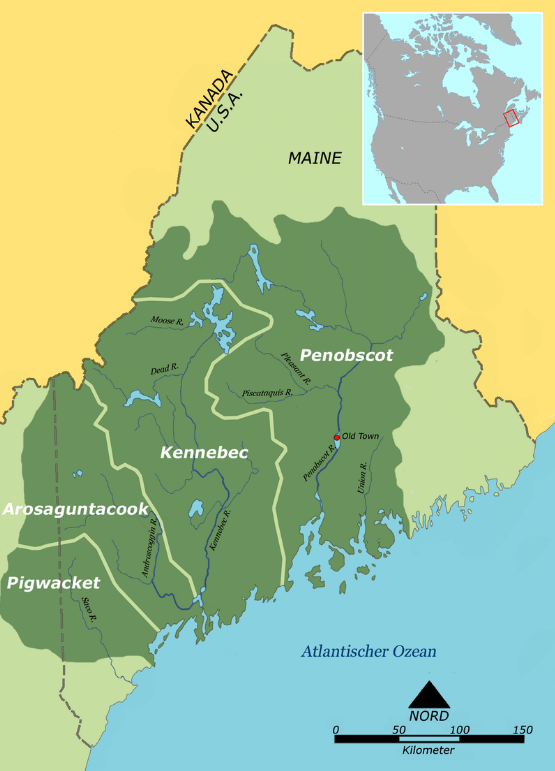
On the Androscoggin, there was a large year-round village at Canton Point near the town we call Livermore Falls. On the Kennebec there was a village on Swan Island and a larger village at Norridgewock, near the town we call Skowhegan. When the fish ran in the rivers, the alewives and salmon, they camped near the falls, like the ones at Brunswick/Topsham and at Lewiston/Auburn.
The Indigenous people who lived in what is now Maine were all part of a broad grouping of Eastern Algonquian people. Those who lived in southern and mid-coast Maine we now call Eastern Abenaki. We can call the people who lived in the Androscoggin Valley the Arosaguntacook. (That’s a name from which the word Androscoggin was probably derived. In their language it means “rocky flats flow” or “a river of rocks refuge.”) Later, in the 1680s, they joined together with other indigenous people in what is now Maine and the Maritimes to form the Wabanaki Confederacy, a word with the same language root as Abenaki. It is a word root that means Land of the Dawn. They were the first people on this continent, the world they knew, to see the dawn each new day
What became of these people when Europeans intruded? Again, this is a story of disease, disruption and dispossession.
Disease. Many of us have an image in our heads of armed conflict or warfare between these indigenous peoples and the European settlers. And there was such conflict, but there is a different and deadlier image we should put earlier than that. From the moment of first contact, the indigenous peoples were exposed to diseases carried by the Europeans, diseases such as smallpox, diphtheria, plague, chickenpox, measles, cholera, syphilis, typhoid and typhus. Those diseases proved enormously deadly to indigenous peoples because they had no immunity to these diseases whatsoever.
Perhaps 75% of the population died in the first decades after contact – that is, in the early 1600s. These epidemics had their most deadly effect before there were colonial settlements. The mere intrusion of Europeans — fishermen or trappers — set off epidemics. The years from 1616 to 1619 – that is, before the Mayflower — are spoken of as ‘the Great Dying’ because in those years, especially in Massachusetts, the deaths were so numerous. Whole villages were wiped out. The arrival of Europeans was lethal to the indigenous people already living here.
The diseases did not just kill people, they also tore apart their ways of living. It deprived them of able-bodied people. It wiped out their leaders. It weakened their confidence in themselves, in those they trusted, and in what they knew.
Disruption. The diseases that the Europeans carried were one kind of disruption, and there were others. The European intruders brought goods with them that the indigenous people did not know. They brought metal goods useful for cooking and for hunting. They drew the indigenous peoples into trading relationships – for beaver pelts, for example. The Abenaki began to hunt not just for their own use but to trade with the Europeans. These new relationships began to change their way of life.
The Europeans also settled themselves on the land in ways that disrupted the more mobile ways of the indigenous peoples. English intruders built a fort at the lowest falls on the Androscoggin, where the building we know as Fort Andross now stands. It was a wooden fort then, but it was a powerful indication that the intruders meant to dominate that site, make it their own. The intruders fished at the falls not just for their own subsistence, but to send salted fish back to Europe for trade and profit. The Abenaki were pushed out.
These were uneasy times. There were insults and thefts, kidnappings and killings. At times the two groups, the intruders and the Abenaki, managed to live near one another without much conflict. But after several decades of the Abenaki trying to live with the European intruders there came to be full-scale war between them. Beginning about 1675 (that’s about 100 years after the first intruders) and lasting for about another hundred years, there was war in this part of Maine that involved the Abenaki. These wars go today by a series of names of our making: King Phillip’s War, King William’s War, Queen Anne’s War, Dummer’s War, the French and Indian Wars. They involved the French as well as the English intruders: these wars were part and parcel of a long struggle between the English and the French for domination of these lands, and each found allies among the indigenous peoples.
In the early stages of these wars, the English settlers were largely driven out. But when these wars were concluded, in the 1760s, it was the Abenaki had been driven out of southern and mid-coast Maine. They had been driven inland, north and east – scattered and decimated.
Today, the eastern Abenaki are not a group that is recognized as having continuing existence by the U.S. federal government. They are a recognized group by the Canadian government in a settlement on the St. Lawrence River in present day Quebec. And, of course, some Abenaki live among us, drawn to living more like we do, but also holding as they can to their long-established ways.
Hattie Cox’s history of this Meeting starts where those wars end. With the Abenaki largely pushed out of southern and mid-coast Maine, the land was open to settlement by European newcomers. Among those newcomers were the original members of this Quaker Meeting. In these parts, the wars ended in the mid-1760s, and this Meeting began just a few years later, in 1775.
Dispossession. What became of their land? There were treaties by which the intruders took possession of large tracts of land. We know those treaties were seen differently by the indigenous people and the intruders. The Abenaki and other indigenous people did not think of land ownership the way we do. And, of course, most of these treaties were not respected – especially not respected by the intruders. Promises were not kept.
The history of land titles in our part of what we now call Maine is full of disagreement and ambiguity and quite complex. But we can say that most of the land we on which we live, work and play, those of us who are members of Durham Friends Meeting, were legally secured by Richard Wharton in 1684, in a deal with six members of the Abenaki that Wharton, at least, considered ‘Sagamores’ or leaders. Whether the Arosaguntacook (the Abenaki in this Androscoggin valley) saw these six as leaders with powers to trade away their land is very much open to doubt. But we can say that this Wharton Deed (it’s also called the Warumbo Deed after one of the Sagamores) contains this provision:
“Provided Nevertheless yt nothing in this Deed be Construed to deprive us ye Saggamores Successessors [?] or People from Improving our Ancient Planting grounds nor from Hunting In any of s’d Lands Comgo [?] not Inclosed nor from fishing or fowling for our own Provission Soe Long as noe Damage Shall be to ye English fisherys,”
I believe every current deed of land within the bounds of this Wharton Deed derives from the deal that was struck that day. (That’s pretty much all the land lived upon by every one of us gathered here today.) And we should remember that in their understanding the Abenaki never after gave up that crucial legal proviso: to have use of the land for planting, fishing and fowling for their own provision. But as the intruders crowded in, the Abenaki were dispossessed. The animals were driven out, their habitat destroyed. Forests were cut and the rivers were poisoned. The land was fenced in and built upon. Roadways replaced waterways. These lands were no longer ones familiar to the Abenaki. The lands no longer sustained their way of life.
Something like this is what we mean when we say that ‘we gather on land that is a homeland for the Wabanaki.’
Perhaps we can remember they had a life here.
Perhaps we can remember that some still live among us.
++++
Here are some resources for better understanding of the Wabanaki on the Durham Friends Meeting website.
You can see a copy and a transcript of the 1684 Wharton Deed on the Maine Historical Society’s Maine Memory Network.
Cross-posted on Riverview Friend.