Following My Thread, By Shirley Hager (Winthrop Center Friends)

Message given at Durham Friends Meeting, October 31, 2021

Before I begin, I’d like to offer an acknowledgement that I’m living on land that was once the home of Abenaki peoples, part of the great Wabanaki confederacy. I realize, with both sadness and gratitude, that I benefit from this land that was cared for here in Western Maine for thousands of years before the settlers arrived. I’ve learned that one-half mile from my house was, for a time, the village of Amesokanti that formed in the late 1600s as Abenaki and other tribes, aided by the French, fled the English incursion into the interior of what is now Maine. That village too was ultimately deserted as the English encroached further.

Let’s take a moment to honor those peoples…

And now, as I’m going to be talking about leadings this morning, I’d like to begin with this poem by William Stafford:

The Way It Is, by William Stafford

There’s a thread you follow. It goes among

things that change.  But it doesn’t change.

People wonder about what you are pursuing.

You have to explain about the thread.

But it is hard for others to see.

While you hold it you can’t get lost.

Tragedies happen; people get hurt

or die; and you suffer and get old.

Nothing you do can stop time’s unfolding.

You don’t ever let go of the thread.

When I was invited to give a message this morning, I decided to speak about my leading to work alongside Indigenous people, and why I focus so much of my life on their concerns, which I’ve discovered are, and should be, all our concerns as well, but I certainly didn’t know that when my journey began.

As I’ve thought about my leading to do this work, I’d like first to offer my own reflection on the difference between a calling and a leading. I’ve not read anywhere that, in the generally accepted use of these words, there is a difference.  I think we typically use these words interchangeably. But to me these two words have slightly different connotations.  I think of a calling as something known to you. As in, I have a calling to be a doctor, or a teacher, etc.  It’s as if you see something calling to you and you begin to work your way toward it.  A leading, on the other hand, implies to me that something is leading you on, but you may have no idea what that something is.  Following that leading is an act of faith because you sure don’t have much else to go on.  It’s an inkling, a nudge, a little voice that won’t be quiet. It’s something that feels right when you follow it and doesn’t feel right when you don’t.

I’d like to read you a bit from my story that gives you a sense of some of those first inklings of a leading that I’ve had most of my life—this is from the book, The Gatherings: Reimagining Indigenous-Settler Relations that I believe many of you are familiar with, co-authored by myself and 13 others-both Wabanaki and non-Native and just published this year. The book tells the story of an experience between Wabanaki people, the Indigenous peoples of Maine, and a group of non-Natives that began 35 years ago, in 1986. In the book, we each tell our story of what led us, Wabanaki and non-Native, to meet together during long weekend gatherings over several years and many seasons in the 1980s and ‘90s.  We met to understand one another and to learn what it takes to have respectful and mutually beneficial relationships across our cultures and our horrific shared history. Bringing this message to you has given me an opportunity to look back at what led me to devote so much of my time, my energy, my whole heart to this endeavor and to the writing of the book that describes it. It also gives me an opportunity to share a few passages with you from the book itself.

As a child, I had a lot of romantic ideas about Native people. Of course, everyone watched Westerns back then, but when I watched Westerns I always sided with the Indians. I remember being fascinated by the tipis and the Indian “villages.” That’s how I wanted to live – the way they lived. I grew up in North Carolina during segregation. My mother was from the South and had stayed close to home most of her life. My father, however, grew up in Missouri, then joined the Navy and was stationed in Colorado; and when he got out of the Navy he went to college on the GI Bill. So, he had seen a lot more of the world, as well as being a very compassionate man. Once, when I was about eight years old, I saw a Black person being mistreated and, although I don’t recall the details, it must have bothered me. I remember being home that evening and looking up at my dad and asking, “Why? Why was this person treated this way?” I’ll never forget his response. He said, “I think it must be that some people put others down to make themselves feel big.” And then he said, “When I was out West they treated the Indians just the way we treat – he would have said “colored people” back then – colored people here.” A light came on for me. Since I had such romantic notions about Indians, if they were treated badly too then all of a sudden the whole system didn’t make sense. Suddenly it all seemed wrong.

I left North Carolina as an adult, and spent six years in Utah, attending graduate school and working. The whole time I lived there, I was aware that there were Native peoples living in Utah, and I hoped that I might meet some Native students at the university, but I never had the opportunity.

Fast forward to 1986. I was by then living in Maine and, at the time, was active with a Quaker peace program based in southern Maine. I heard about a new peace and justice organization that was devoted primarily to promoting sustainability in the Gulf of Maine bioregion, namely Maine and the Maritimes. This organization was called the Center for Vision and Policy (CVP), and I thought that the two organizations should be introduced. I contacted the founder of CVP, Elly Haney, and we met one morning at a local Portland diner. She filled me in on CVP, their activities, and plans for the future. Their plans included a particularly notable decision for a primarily “White” organization: a commitment that any vision of sustainability should include the perspective of the Indigenous people who had lived for thousands of years, and continued to live, in the bioregion. I was completely hooked:

[From the book] Currently the CVP board was mulling over the question of how to reach out and find Native individuals who would be interested in participating in this endeavor, and Elly [the founder of CVP] admitted they were pretty much clueless about how to start. She planned to contact existing Native organizations as well as a few people whose names she had been given, but was feeling less than confident of a positive response….[I said]“Well, I’m going to a New England Quaker gathering in Amherst next week,  producing the brochure from my purse. “There’s a Wampanoag man named gkisedtanamoogk” – whose name I couldn’t yet pronounce – “speaking there. Maybe I could talk to him.”

How the resulting Gatherings between Wabanaki and non-Native individuals that we speak about in the book came to be is a story much too long to tell in the time I have here but suffice it to say that my connection with gkisedtanamoogk proved to be the catalyst for everything that happened after that. The Gatherings developed over time, with much deliberation and planning, primarily between gkisedtanamoogk and myself. But once we began to meet in the Gatherings, it was the feeling that what we were doing was, as Quakers say, a “rightly ordered” thing to do, that kept me committed.

I’d like to share a pivotal moment for me that arose in the Gatherings.

The first Gathering that we held was a typical educational event, where we invited Wabanaki speakers to talk to us, the non-Natives, and educate us about their history, our shared history, and current issues in their lives. It went well enough that we decided to hold a second Gathering the following year.

[From the book] During the year after our first Gathering, when we were planning the second one, gkisedtanamoogk offered to build a Fire and to have a First Light ceremony there. This was before our decision to hold all of our meetings around the Fire, and so his suggestion caught me by surprise. I was tremendously excited because I had wanted to experience something like that my whole life.

Native women had already told me that when women were menstruating they didn’t participate in these ceremonies. Sure enough, that’s what happened to me and, after all the anticipation, I was crushed. While the ceremony was going on, I left the group and climbed one of the little hills overlooking the retreat center. I lay down between a couple of big boulders on the hillside and dissolved into tears. I had worked all year to put this event together and I wasn’t going to experience the very thing I had looked forward to the most. I remember praying up there among the rocks and asking for answers, or at least a way to cope with my disappointment, and what came to me was … this was a test of my commitment. We didn’t create this event so I could take part in a ceremony. This was about something much bigger, and I needed to accept things as they were, even though I didn’t fully understand them or necessarily agree with them. I think I grew up a little that day. I came to a realization of the seriousness of what we were doing, and that it was important to stay with it, no matter what.

[Important note: this practice of excluding women during the “Moon Time” as it was referred to, I understand from Wabanaki individuals has been challenged by women and men alike and I believe that it is rare now to see women sitting outside the Circle.]

I did, of course, get to experience the ceremonies and the Circles in which we met many times over the years.

And, as time went on, I say in the book:

I remember a distinct feeling of “filling up” as the Talking Stick would go around and the stories would be shared. Another way I describe it is, it felt like a wound healing that, until then, I didn’t know was there. I think that we White people carry around the wounds of the separations that we’ve created, whether it’s our separation from Native Americans or African-Americans, or from the land itself. Oppressed peoples feel the brunt of the system we’ve created, but we feel it too. We suffer from the separation without being aware of it most of the time. Being in those Circles was a spiritual experience, I don’t know any other name for it; as if we were doing something so right with Creation that you could feel it…

What kept many of us coming back to these Gatherings, kept a number of us in touch all those years since the Gatherings ended, and led the 14 of us to create this book about our experiences can only be attributed to the feelings that we had in being together. 

My experience in those Circles was perhaps the strongest sense I’ve ever had of being supported, even carried, by the Spirit. What we were doing felt so right—the sense of healing something that had been tragically broken, the feeling of being held together around the Fire that was lit for us every time—these are feelings that I have had in a few other situations, even occasionally in Quaker meeting, but never so consistently and so long-lasting as the sense of rightness that carried over from one Gathering to the next and was still present after nearly twenty-five years when we first came back together around the making of this book.

There are so many aspects of this experience that I could share with you—it was hard to choose. But I wanted to focus this morning on this experience of rightness, of participating in what God, Creator, the Universe wants to happen. I feel entirely blessed to have known this feeling. And only in reflecting back over my life can I identify those nudges, and recognize the still, small voice urging me onto the path that eventually led me to participate in the Gatherings, and to co-create this book.

I want to leave you with some queries for your own life: can you identify times when there were inklings, nudges, tiny voices, urging you in a certain direction?  Did you listen? Or not? Can you remember occasions when you felt a certain “rightness” in what you were doing? What was that like? Have those occasions informed the rest of your life in any way?

There’s a thread you follow. It goes among

things that change.  But it doesn’t change…

You don’t ever let go of the thread.

Has there been a thread that you’ve followed in your life?

Thank you.

Durham Monthly Meeting Minutes, October 17, 2021

            Durham Monthly Meeting of Friends met virtually for the conduct of business on Sunday, October 17, 2021, with 20 people present.  After a period of silence, Clerk, Bob Eaton, opened the meeting.

1.The September minutes were approved as printed in the October Newsletter.

2.Finance Committee: Sarah Sprogell, clerk of the committee, reported that they met on October 15 to discuss where to place the net proceeds from the September sale of the parsonage.  The sale price was $250,000 and after expenses we received a check for $238,045.95 which was deposited into the meeting’s checking account.  The Finance Committee recommends that $238.000 be placed into a New England Yearly Meeting pooled fund with any earnings and dividends to be reinvested in the account, while the meeting takes time to discern its ultimate use or uses.  We expressed gratitude for the work of this committee.

3. We approved the recommendation that $238,000 be placed into the NEYM pooled fund.

4. The Clerks of Meeting Group met by Zoom on 13 October 2021.  Those present were Ingrid Chalufour, Renee Coté, Bob Eaton, Tess Hartford, Wendy Schlotterbeck, Liana Thompson-Knight and Sarah Sprogell.  The Clerks Group is an informal meeting of the clerks of the various committees of the meeting.  It serves as an informal forum for mutual support, information sharing and discussion of meeting issues that may not fall within the mandate of a single meeting committee.

            They addressed the issue of the large cash infusion to the meeting resulting from the sale of the parsonage. The question of how these funds should be considered for the long-term requirements of the Meeting needs attention and falls outside of the limited mandate of the Finance Committee.  They recommend that an ad hoc group be established to give seasoned consideration to the disposition of the proceeds from the sale of the parsonage and to report its recommendations to Meeting for Business.  The group should not feel under pressure for a quick decision but rather meet with an expectation of careful discernment that will involve members of meeting as appropriate.  They recommend that the composition of the ad hoc group consist of the Clerks Group, and three other Friends nominated by the Nominating committee and approved by the meeting.  Margaret Wentworth was recommended as a member of the ad hoc group. 

            The meeting felt that we should have an open listening session to discuss the suggestions made by the ad hoc committee.

5. Trustees:  Kitsie Hildebrandt reported for Trustees who are providing basic information on our Green Burial Area. 

“Green Burial Lot Agreement:

            Single lots are available for purchase in Lunt Memorial Cemetery. Each lot measures 4’ X 8’, allowing room for a small marker and flowers.

            The charge for members of Durham Monthly Meeting of Friends is $200.00, the charge for non-members is $350.00.

            A lot may be transferred from one owner to another, only with the approval of the Trustee in charge of the cemetery. If a lot is unused and a written request to return the lot is sent to the Trustees of Durham Monthly Meeting of Friends within 10 years of purchase, half of the purchase price will be refunded. 

            A green burial is an unencumbered burial. There is no embalming and no need for a commercial casket.

            The body may be wrapped in a cotton shroud or other decomposable fabric and placed directly in the ground or placed in a plain wooden box and placed in the ground. The required depth for the green burial is 3’.” 

            This information can be found in the Durham Monthly Meeting of Friends Handbook.

            Concern was raised about digging of the grave, winter storage of the body, and cremation details.  Cush Anthony suggested contacting the Funeral Alliance of Maine for information. 

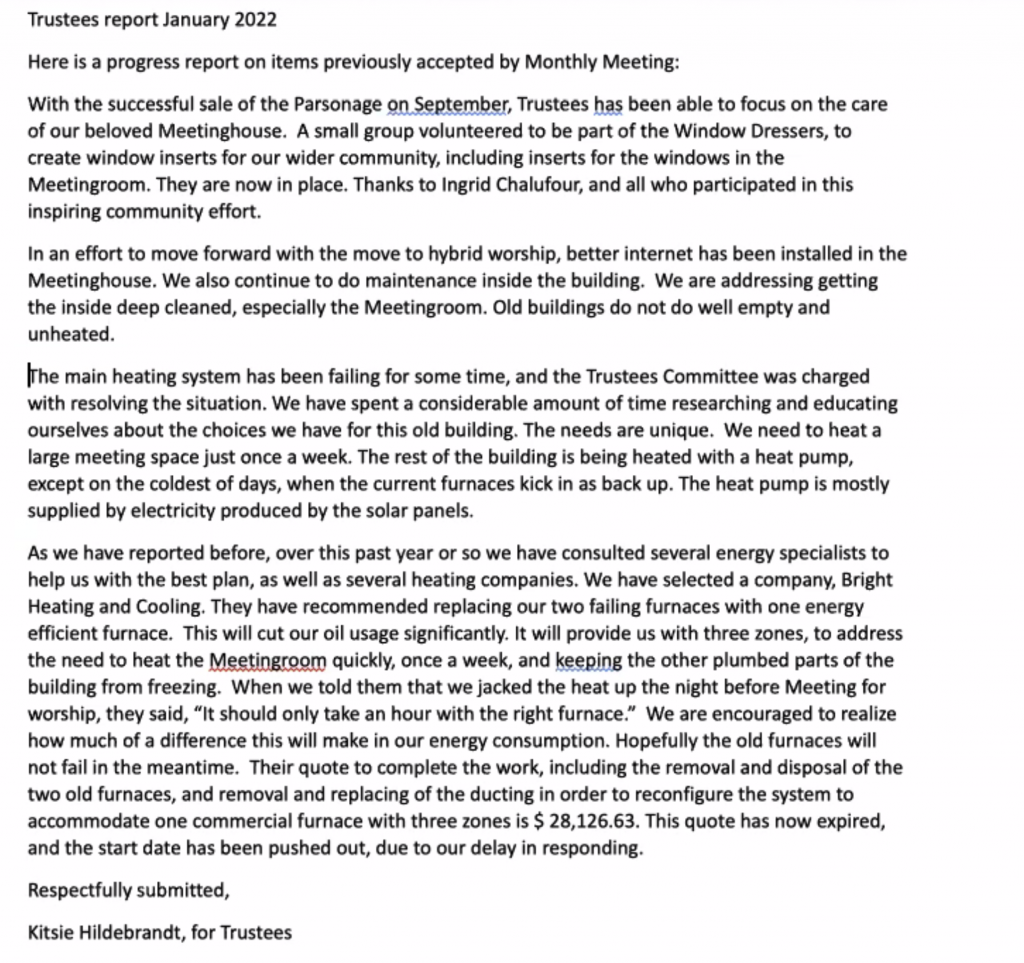
            Trustees reported that the parsonage area which includes the building, well and septic on a surveyed lot of just over 2 acres was sold on September 24, 2021.

            We excepted their report with gratitude.

6. Ministry and Counsel:  Renee Cote reported for Ministry and Counsel.  The meeting has purchased the Meeting Owl and have developed a list of arrangements that will be needed for implementation regarding hybrid worship.

            Wendy Schlotterbeck and Leslie Manning are preparing a report written by Martha Hinshaw Sheldon summarizing the Meeting Care Coordinator position, to be presented in November.

            A support committee is in process for Leslie Manning’s emerging ministry with women at the Women’s Center of the Maine Correctional Center in Windham. 

            Ezra Smith has requested a clearness committee for marriage; Tess Hartford, Doug Bennett and Edwin Hinshaw have volunteered to serve. 

            Hybrid worship: Ministry and Counsel is making arrangements to provide hybrid worship which will allow most people to attend meeting in person while allowing others to participate remotely via Zoom.  Their plan and proposals include technical set up using the Meeting Owl, cleaning and safety preparations (install air purifiers), human support arrangements, and meeting participation protocols (vaccination requirement, masks, six feet distance, and no food/refreshments).  They will monitor scientific advice for possible modification or relaxation of these requirements.  Issues to consider: children without vaccination, information for visitors, and message givers in person only?

            A complete list of these suggested arrangements will be attached to the minutes and included in the Newsletter.

7. Falmouth Quarterly Meeting: Leslie Manning, Sarah Sprogell, and Bob Eaton volunteered to be representatives to Quarterly Meeting which meets Saturday, October 23rd 10:00 TO 12:00 via Zoom. 

            `The meeting ended in quiet waiting, and gratitude was expressed for the presence of those in attendance.

            Dorothy Hinshaw, Recording Clerk

Falmouth Quarterly Meeting, October 23, 2021, 10am to 12pm

Falmouth Quarterly Meeting will gather via zoom on Saturday October 23, 2021 from 10 – 12.

The zoom link is: https://us02web.zoom.us/j/84328194455?pwd=dHJNdTVhR3BXQ0Z3OU9qZ2ZzL1U1dz09

The October meeting is a business meeting focused on the essential work of the quarter and on sharing news from the constituent meetings.  The essential work of the quarter is caring for each meeting, nurturing the ministry rising among us and strengthening our beloved community.  All are welcome, and all enrich us.

  • We will hear from each meeting – the joys, concerns and life that each meeting is experiencing.  Please name a person to report and consider Where is spirit leading you /your meeting? Where is the energy in your meeting?
  • We will hear from the annual sessions of New England Yearly Meeting.  The presiding clerks letter is attached.  I specifically draw your attention to the minute and letter endorsed concerning the impact of the US policies on Cuba as we will consider whether we should send a similar letter to the Senators from Maine.
  • The Yearly Meeting has also approved a letter of apology to Native Americans. The letter with a word of caution is attached. This is a concern that Friends in Maine have carried for some time and there may be updates on our work towards right relationship.
  • Falmouth Quarter will be hosting the All Maine Gathering this year on May 7th.  The planning for this could begin now.  I’m personally expecting that by May we could gather in person and would be happy to reserve the Friends School Campus for this event.
  • If there is time, I hope we might consider how the quarter will hear from and support those Friends among us with recognized public ministries.
  • There is some more mundane business – a budget, archives etc. as well.

I look forward to seeing you again, even on zoom.  We did have a lovely gathering in person in early August and I treasure the promise that we will gather in person again.

Love, fritz weiss, co-coordinator of Falmouth Quarter

Discussion of Reparations, October 5 and October 20, 2021, 7pm


Peace and Social Concerns invites us all to talk about the great injustices done to Black Americans and how communities and organizations are responding. What have we been learning? How are we feeling?

Background materials for the two sessions are here.

Tuesday October 5, 7:00 PM at the Meeting Zoom site [connection information here]

On Tuesday, October 20 (also 7 pm) we will talk about how we as individuals and a community are led to respond. 

Durham Monthly Meeting Minutes, September 19, 2021

Durham Monthly Meeting of Friends met virtually via Zoom for the conduct of business on

Sunday, September 19, 2021, with 14 people present.  Clerk, Bob Eaton, opened the meeting with quiet worship, and continuing in worship we proceeded to conduct business.

1.The June and July minutes were approved as printed in the September Newsletter.  It was noted that there were no Newsletters for July and August; therefore, the previous number 1 minute in the July minutes was in error.

2. Trustees:  Katharine Hildebrandt reported the following:

            The Parsonage: With the approved minute from Monthly Meeting for Business, dated July 18, 2021, which read, “Friends approved the recommendation of the Trustees to sell approximately 2 acres including the parsonage, well and septic field on the open market. The trustees and clerk of the meeting are authorized to accept a final offer on behalf of the meeting.” Trustees are now under contract with a buyer.  The survey has been completed, along with other details related to the sale of the property.  The clerk of Trustees will meet with the Treasurer and the Clerk of the Meeting to go over the details of the sale ahead of the closing on Friday, September 24, 2021.

            The Meetinghouse: The repointing of the brickwork on the Meetinghouse has been completed for now.  This work included replacing the three gable-end windows and scraping and painting the exterior trim. The interior has had significant improvements over this past period of time in terms of floor refinishing, plaster repair, and paint. Trustees are hoping to now turn our focus on the work we can do to address the “Greening” of our Meetinghouse.

            The Lunt Cemetery: The Green Burial section of the Lunt Cemetery has been partially enclosed with a split rail fence, to be completed soon.  Trustees will bring a report containing information on the Green Burial site to the next Monthly Meeting.

            We expressed appreciation for the work of the Trustees.

3. Peace and Social Concerns Committee: Ingrid Chalufour reported.  They hope that everyone has been reading the reparations articles they are sharing on the website. They are planning a lively discussion on October 5 at 7:00 PM via Zoom. A second discussion, focusing on how we might respond to the call for reparations, will be on Wednesday Oct. 20 at 7:00.

            The Social Justice enrichment branch of the committee has had a busy summer distributing books to New Mainers and preparing to give books to 9 teachers of young children.  Fifty Brunswick New Mainer children have received their books and 17 Bath children will have theirs very soon. The first week in October each of the 9 teachers in the first year of the project will receive 7 books that will support children’s learning about and value for diversity, peaceful conflict resolution, Wabanaki and African American history, and caring for the environment. The committee will share more about this project in a message later this fall.

            From the Greening the Meetinghouse work group: Window Dressers, the volunteer organization that makes window inserts, has measured our worship room. The cost of 10 window inserts will be $609. These inserts will cut down on cold air leaking into the room and should reduce our use of oil. The workshop where the inserts will be made October 18-22 at the Episcopal church on Pleasant Street in Brunswick. We are expected to provide a few volunteers to help. There are morning and afternoon sessions, and an evening session on Wednesday the 20th. The work is organized in a way that a novice can easily contribute by learning one step in the process. Please contact Ingrid Chalufour by email if you want the link to sign up as a volunteer.

            We acccepted their report with appreciation.

4. We approved the requested amount of $609.00 for window inserts.

5. Ministry and Counsel: Renee Cote reported the following:  In June, Monthly Meeting approved the request from Ministry & Counsel to purchase the OWL to allow us to transition from ZOOM-alone to a hybrid form of worship in which people can either come to the Meetinghouse or participate via ZOOM.  Two M&C reports, one from June and one from July, about hybrid worship are available if any Friends would like to review them.  After an August pause and considering the emergence of the Delta Covid variant, “we will continue planning this transition in the coming months.  We aren’t ready to make regular use of the Meetinghouse yet, for reasons both of safety and of needed technical preparation, but we will be working on these and appreciate Friends’ patience with continued use of ZOOM as our primary mode of worshipping together.”

            Leslie Manning has requested a “care and accountability committee” for her chaplaincy, which will involve support for those involved in different phases of the carceral process and their loved ones. They approved this request and look forward to its development.

            It is with sadness that they report that Tom Frye died August 29, 2021.  Sarah Sprogell reported that Ezra Smith built a simple pine box for Tom, per Tom’s request for a green burial at the Lunt Cemetery. A small group of caring Friends from the Meeting were on hand Monday to prepare the earth, transport Tom’s remains to the cemetery, return his body to the earth, and close the grave.  “The Spirit was indeed moving among us in many ways; most notably, it happened that Peter Crysdale faithful and caring Friends who were present on Sunday and Monday also became “essential workers” in this process, either in transferring Tom’s body or in preparing the ground. Tom’s final passage was handled with a simple and very personal stewardship, a sacred and very physical task. Gene Boyington, Katharine (Kitsie) Hildebrandt, Donna Hutchins, Ezra Smith and Teresa Oleksiw helped prepare the ground for burial. Ezra, Jim McCarthy, Linda Muller, Kitsie, Sarah, and Denise (a friend of Jeri and Tom) moved the pine box into Ezra’s truck for transport; Peter Crysdale, Tess Hartford, and Ann Ruthsdottir joined us at the cemetery for a tender gathering of hearts to remember Tom and hold Jeri (caregiver) in our care. Many from this group remained to help close the grave, bringing Tom’s body to its final resting place in the embrace of Mother Earth’s soil. As the raindrops fell, we watched a rainbow appear before us.”  Gene Boyington, Sarah Sprogell and others will prepare a memorial minute.

6.  Finance Committee:  Sarah Sprogell brought the six-month financial report which is attached.  We are thankful to have spent only 37% of our budget.  We thank this committee for carefully overseeing our finances.

            We closed in quiet worship, thankful for the careful reports from committees, Trustees and Ministry and Counsel. 

            Dorothy Hinshaw, Recording Clerk

“War and Foolishness,” by Doug Bennett

Message given at Durham Friends Meeting, September 19, 2021

War is what’s on my mind and in my heart today – and foolishness, too.  War and foolishness because war, I believe, is one of the most profound forms of human foolishness, and tragic, too.  War and foolishness have been on my mind because of the recent end of the war in Afghanistan and also because of the recent 20th anniversary of 9/11 and the subsequent launch of the ‘war on terror.’  Hundreds of thousands of lives lost – who knows how many? – and trillions of dollars spent badly. 

In October of 2012 –I jotted down the following list of things that are likely to happen in a war – things that are likely to happen beyond soldiers being killed or wounded.  I don’t remember what led me to write down this list.  This was nine years ago, and eleven years after 9/11.  Most U.S. troops had left Iraq a year earlier, and U.S. troops would still be in Afghanistan for almost a decade longer.  So I don’t remember why I jotted down this list.  We were very much in the middle of a never-ending war, as we always seem to be. 

  • Young lives will be ruined.  The survivors will wake with terrible memories. 
  • Civilians will be killed.
  • The costs will be much, much higher than anticipated.
  • Unspeakable acts will be committed, some by us.
  • Civil liberties at home will be trampled.
  • There will be secrecy and lies that undermine democracy.
  • We will worsen our relations with some otherwise uninvolved friends and serve the purposes of some opportunistic bad actors.
  • We will create massive, distant wreckage that we will not want to repair.
  • We will entangle ourselves in ways that will make it hard for us to disengage.
  • We will set in motion an unfolding humanitarian crisis that will last for years: refugees, divided families, deprivation and the like. 
  • We will sow the seeds of future conflict. 
  • We will fail to learn lessons of peacebuilding because we won’t have tried it, again. 

All these things happened in Afghanistan.  All these things happened in Iraq.  And they happened in Syria and Lebanon and Libya, too – and not only in those places.  It would be foolish to go to war and not expect that most of the bad things will happen.  Those who support wars should have their eyes wide open and their hearts hardened in anticipation of these tragedies. 

I’ve opposed this sequence of wars.  When I’ve written my Senators or written a letter to the editor, I’ve talked about these terrible things that are likely to happen and urged them to oppose these wars.  I’ve mostly written about things on this list. 

Let’s call the items on this list the prudential arguments against war.  War won’t get us where we want to get to.  It won’t bring peace; it will bring further war.  It will not bring understanding; it will bring mistrust and hatred.  War today will bring war tomorrow.  You’d have to be foolish to expect anything else.  We have abundant recent evidence. 

But these prudential reasons for being against war aren’t really why I’m against war.  These prudential reasons are important – very important – but deep down I know I am against war because I am a foolish person – foolish in a very different way. 

I’m a different kind of foolish person because I’m a pacifist. 

I became a pacifist in the late 1960s during another war, the one in Vietnam.  (All those bad things on the list happened then, too; they always do.)  I became a pacifist before I became a Quaker.  It was in understanding why pacifism made sense, even though it was foolishness, that I found my way to Quakerism.

Why is pacifism a kind of foolishness?  Do you even need to ask?  Tell someone you are a pacifist and they look at you with utter dismay and incredulity.  Voiced or unvoiced you hear a torrent of questions.  Would you have let the Nazis win?  If someone attacked your mother, wouldn’t you try to stop the attacker?  If they attacked your wife? Your children?  Would you really not raise a hand to stop an aggressor? 

It’s unfathomable; people can’t believe you’re serious; as soon as you say you’re a pacifist they know you are a fool. 

You certainly put yourself beyond the boundaries of reasoned argument.  You can no longer have any standing whatsoever in discussions of foreign policy.  There is no point in writing your Senator and telling her she should oppose a war because you’re a pacifist.  That letter will carry no weight.  When you say you’re a pacifist you put yourself out of bounds – beyond the pale.  Only ‘serious people’ get to participate in the decisions about going to war – and no ‘serious person’ is a pacifist.

I understand being a pacifist is foolishness.  It’s a very, very different kind of foolishness from the foolishness of thinking that war won’t bring those twelve terrible things I listed before.  You have to choose which kind of foolishness is yours:  believing that war will work, or believing that one door to a different, better world (the “beloved community”) is marked “I will not go to war.”  Let’s call the pacifist argument against war the transformational argument against war.  It’s an argument deeply grounded in Jesus’s argument to love your neighbor as yourself. 

“What if everyone acted like you did?”  That’s one of the torrent of questions you provoke if you declare for pacifism.  And that one question is easy to answer:  You can say, that would be wonderful.  You have to believe – you should believe – that everyone can and should make the same choice, the choice to say no to war.  Not just your family and friends, not just your fellow citizens, but everyone would make the same choice. 

Pacifism is a kind of foolishness that begins by saying I am not going to accept that what has happened over and over again is the only possibility. 

“I told them I lived in the virtue of that life and power that took away the occasion of all wars.”  That’s from George Fox, of course.  He’s saying, I took myself out of this world and put myself in a different world.  And, he might well have added, I’m not coming back. 

Join me in the that new world, Fox is saying.  Sign up for the foolishness that says there are new possibilities.  We can do this together.  We can choose to love one another.  We can put ourselves into an understanding that each and every one of us is a child of God, capable of giving and receiving love.  But each of us has to begin by making the individual choice to say no to war.  Each of us needs to make a solid commitment to the way of love, not a tentative or half-hearted, ‘but you go first’ one. 

Yes, that’s foolishness.  It is a rare and wonderful kind of foolishness.  Here’s a statement from British Friends in 1920 – that is, just after the end of another horrible war – in which all those terrible things happened. 

“When the early Friends said that the ‘Spirit of Christ would never move them to fight and war against any man with outward weapons!’ they not only testified that war was wrong, but they also indicated that there was a new and right way of dealing with men consonant with Love, and certain to be attended by a success far greater than had ever been attained by war. Instead of destroying or suppressing the evil-doers, the new method would transform them into children of light. These early Friends were come ‘into the Covenant of Peace which was before wars and strifes were’ and by their lives lived in the power of the light they were helping others to enter that same covenant.”

Or as A. J. Muste once put it, “there is no way to peace; peace is the way.”

Yes, pacifism is foolishness by the world’s lights, but it is, I believe, a far, far better foolishness than the endless alternative of war. 

So here is the choice, a choice between two kinds of foolishness.  Do you choose the foolishness of war and its terrible train of tragedies, or the foolishness of a new life lived in love?

Also posted on Riverview Friend.

“Praying for Zoom Support,” by David Coletta

Message given at Durham Friends Meeting, September 12, 2021, by David Coletta, Three Rivers Meeting

Good morning, Friends.

I want to thank you for inviting me to bring the message this morning. Just to say a little about where I’m bringing it from… I live in Boston, but I happen to be in Hanover, New Hampshire this weekend, so that’s where I’m physically Zooming in from. Back when you invited me a couple of months ago, it seemed like maybe by now it would be safe to come visit you in person to give the message, but it didn’t turn out that way. And this is only the second time I have ever brought a prepared message to a Quaker meeting. The first time was a couple of months ago, as one of the hosts of Three Rivers, where we bring a prepared message each time. As you heard in the introduction, Three Rivers is a worship experiment that has been meeting online under the care of Fresh Pond Monthly Meeting since the beginning of the pandemic. Before it was Three Rivers, it was a project called “Quaker Dinner Church” started by Kristina Keefe-Perry. As a worship experiment, we are not even formally a worship group, although we are hoping to gain formal status as a preparative meeting under the care of Fresh Pond some time in the next year or so. Anyway, I’m grateful for the opportunity to bring a message a second time.

There’s someone here at this meeting today who is responsible for the “Zoom” aspect of worship, and sometimes that person is called the “tech host”. I think maybe you call it “Zoom support” here? I’d like to take a moment now and invite us all to hold that person or people in prayer as they work to support us.

Thank you, Friends. A little later on I’ll say more about why that bit of prayer is important to me.

But first I want to share about my personal journey of the last 18 months or so – how I came to this work. At the beginning of 2020 I finished a career in software engineering. For quite some time before that, I had been aiming at February 2020 as the time to wrap up my software career and start something new. My work had been focused for a long time on technology, and I wanted to transition into doing work that was more about connecting with people. I really didn’t know what the work was going to be, but only a few weeks after I quit my job, I found out. There was this Sunday in March 2020 when we went to our local meetings in person, not realizing that it was going to be the last time for a while. And then the very next Sunday many of our meetings held worship online via Zoom for the first time. It wasn’t yet obvious to me what my work was going to look like, but what struck me then was how many folks were going to need tech help in order to do the basic things that were necessary in order to join Zoom worship: besides getting Zoom to work, it suddenly became important to manage all these Zoom links somehow! So I made a website where people could sign up for free one-on-one tech help, and I spent some time every day helping people figure this stuff out. This turned out to be excellent preparation: it was obvious, it was sorely needed, and it was challenging for me. I was used to having complete command and facility with technology, and this work required me to develop compassion and understanding for what it felt like not to be in command.

Back to Friends Meetings. It quickly became clear that it was one thing to hold meeting for worship over Zoom, and quite another to hold meeting for business. I studied how Beacon Hill Friends Meeting and Friends Meeting at Cambridge were experimenting with the features in Zoom like “raise hand”, and noticed how some of our business practices were being modified in small ways to accommodate the needs of the clerks’ table and of the body in an online setting. I found opportunities to try being the “tech host” for worship and business, and helped write some of the guidelines we were using. I joined these new things called “tech teams” at Beacon Hill and Cambridge, who met every week or two to identify tech hosts for events, teach each other how to use the tech, and generally huddle for warmth and mutual support. It was and is challenging work. 

By now it was early June and I could see we were going to need this same work to happen at Yearly Meeting sessions, which were going to have to be online if they were to happen at all. I approached the Yearly Meeting staff and offered to recruit and lead a team of volunteers who would do the tech hosting work for the business meetings and plenary events of Yearly Meeting sessions. We only had about eight weeks to prepare, and these were eight of the scariest weeks of my life. I had seen business meeting work over Zoom at the monthly meeting level, but I had never seen it work with hundreds of people present. A great blessing for us was that New York Yearly Meeting was a couple of weeks ahead of us all summer long in their preparations, so I reached out to my friend Jennifer Swann who was helping New York Yearly Meeting figure out their sessions tech, and the two of us worked together to bring those learnings to New England. At the same time, amidst all that fear, there was a still small voice at the center of it all telling me that I was in the right place, doing the right work at the right time, that I had been preparing for that work my whole life, and that everything would be okay. That everything already was okay.

This is probably a good point to explain why praying for the tech host is important to me. When the tech for a Zoom meeting is going well, it’s invisible. Everything just works. And this is like so much of the infrastructure in our world that we take for granted: we mostly only think about electricity when the power goes out, right? But the tech team is doing all sorts of little things, quietly, invisibly, to make sure that everything just works. Being on the tech team can feel a lot like being on the backstage crew of a theater production! But that’s not what we’re doing in our meetings for worship and business: it’s not a show, it’s a living, breathing witness to the promptings of the Spirit. So we don’t judge our meetings by how well the clerk hits their cues, or whether the finance committee report starts and ends on time. When we pray for the tech team, it’s a chance to let go of our expectations that the show follow the script.

After 2020 sessions I was hungry for more of this work. So in the fall, I went on to recruit and lead the tech team for FCNL’s Annual Meeting, and in the spring of 2021 for the FWCC Section of the Americas meeting, and then this summer for our recently concluded 2021 Yearly Meeting sessions. I learned more and more at each of these conferences about the work and how to lead it. My first priority was not to put on a glitch-free show, but to create a fulfilling opportunity for service for the people on the tech teams. That meant providing training and practice sessions, it meant not asking any one person to do more than they were capable of, and it meant putting structures in place by which we could support each other. The work can be really scary! Press the wrong button and end the meeting by mistake? That happens! And it feels terrible! And yet it somehow has to be possible to move past these mistakes with the understanding that God is inviting us to be faithful — not perfect! What makes that moving-past possible is being present to each other, over the physical distance, praying for and supporting each other, literally whispering messages of support — and reminders of upcoming cues — in each others’ ears. So another thing that is mostly invisible to you when you go to a big Zoom event is that we members of the tech team are connected to each other in additional ways beyond Zoom, via invisible threads of technology. And these connections somehow manage to restore a great deal of the intimacy of being together in person, for us on the tech team to be sure, and maybe for everyone else too.

So with all that in mind, now I want to talk about a stark contrast that I have been experiencing this year. It’s a contrast between the richness and sense of great abundance that I feel on these tech teams at big Quaker events, versus the burnout and sense of scarcity that I hear about when I meet with Friends’ meetings who are trying to discern the way forward with online and hybrid worship. And it’s different for different sized meetings. Some of our smaller meetings never went on Zoom at all: they kept meeting on each others’ porches, or they met each by themselves in their own homes at the appointed time. Some of our bigger meetings formed tech teams and created that same sense of mutual support that I described. And our medium-sized meetings struggled. I heard stories of meetings where there were just one or two people doing all the tech hosting, and they were tired and burned out. And this was just from holding online-only worship. When they heard that holding hybrid worship was even more work, it was as if I was describing a trip to another planet.

Friends, we are tired. The work of holding our communities together when we can’t be together in person is hard work. We are tired from not being able to come together for our Yearly Meeting sessions, tired from being afraid for our health and safety when we perform the basic functions of daily life, and so, so tired of the uncertainty. It can feel like we are wandering in the desert sometimes. And you know we have lost folks along the way. Friends for whom online worship just doesn’t work. Friends whose passing cannot be commemorated in person. And our young Friends, for whom Zoom church and Zoom retreats on top of Zoom school is just more Zoom than anyone should be asked to endure, let alone kids. When we are this tired, we yearn for things to go back to normal. That’s legit, right? Please just let us all come back to our meeting houses together and sit next to each other and sing together and shake each others’ hands and feel safe and connected. Let’s take a moment now and hold that yearning in our hearts, breathe into it, and acknowledge that it’s a totally valid thing to want.

One of the things I had to learn the hard way during the pandemic is that there are at least a couple of different ways that Friends respond under these circumstances, in the ways that we care for our meetings for worship. One is what I’ll call “holding”. It’s about calming, being careful and predictable, about protecting meeting for worship, and resisting change. The other way some folks respond is what I’ll call “experimenting”. It’s about changing, learning, about embracing chaos, about making lots of mistakes, and figuring out new things that work. Both of these kinds of care are needed! As you might guess, my response was mostly about experimenting, and I came up against a lot of resistance to that in the week-in, week-out meetings for worship of a local meeting. I had to accept that I was going to have to create my own opportunities to experiment, and as it turned out, the large events with big tech teams were the perfect place, because that abundance of energy and creativity and connection that came with such a big tech team created the safety within which to experiment. That experimentation was and is a big part of what sustains me through this time. But I want to caution you: every meeting needs both kinds of care, holding and experimenting. If your meeting tends to lean in the direction of holding, don’t forget to embrace and support those among you who want to experiment and learn. And if, like Three Rivers, your meeting is all about experimenting, remember those folks who come each time looking for something that feels familiar.

I want to share with you the vision that has been breaking through for me, just here and there a little, of what’s around the corner for us. One of the things we have been learning about online and hybrid worship is that it’s an opportunity to create accessible space for those Friends we were leaving out in the “before times.” People who couldn’t come to the meetinghouse because of health or distance or ability now can join online. People who could come, but couldn’t hear, now can read closed captions. And these are just a couple of the many ways that our meetings have become, and have the potential to become, more accessible. 

When I think about and speak about hybrid worship, I try to resist the idea that it’s centered in the physical meetinghouse, with a few remote participants. Instead I talk about it as an online meeting in which some of the “Zoom squares” have groups instead of individuals in them. One of those groups might be the folks at the meetinghouse. Some of those groups might be families at home. By my definition this meeting today is a hybrid meeting for worship. Maybe that was already your picture of hybrid worship! If it wasn’t, try it on for size. 

I feel like one of the effects of the pandemic has been to atomize us into soap bubbles! Early on during the pandemic we tried to stay in the smallest bubble we could. Later on some of the bubbles popped as things got safer. Maybe now we are trying to find smaller bubbles again. It’s like some of the bubbles are popping and joining together, and other new ones are forming. But imagine that we start to actually get good at this. Good at holding meeting for worship with bubbles of all sizes, and at adapting the sizes of our bubbles as the needs of the pandemic dictate. Who’s to say where it stops? If we can hold hybrid worship in one meeting with lots of different sized bubbles, could we join two meetings together in hybrid worship? How about a whole quarter? or a yearly meeting? What does this mean for the idea of your “local Friends Meeting”? What does it even mean to be a “Friend at a distance” any more? And what does it mean for the burnout and exhaustion that many meetings are experiencing? Maybe it’s okay to let the meeting down the road do the online hosting, and just show up? Maybe each meeting doesn’t have to do it all on their own? Maybe it’s okay to let down some of the boundaries that separate us?

By the way, if you find hope and inspiration in this vision, I recommend reading Emily Provance’s piece called “Fruit Basket Upset and the Eighth Continent”, published in March 2021. I’m indebted to her for some of these ideas, and I share her sense of hope.

I want to close with a poem that I first heard at Three Rivers. It’s called “The Way It Is,” by William Stafford, and best as I can tell it was first published in 1998 in his collection of the same name. For me this poem touches on what it feels like to be doing this particular work in this moment.

The Way It Is, by William Stafford

There’s a thread you follow. It goes among

things that change. But it doesn’t change.

People wonder about what you are pursuing.

You have to explain about the thread.

But it is hard for others to see.

While you hold it you can’t get lost.

Tragedies happen; people get hurt

or die; and you suffer and get old.

Nothing you do can stop time’s unfolding.

You don’t ever let go of the thread.

Malaga Island, by Surya Milner

Peace and Social Concerns Committee encourages members and attenders of Durham Friends Meeting to read “Inhabited: The Story of Malaga Island,” by Surya Milner (Bowdoin College ’19).

Here’s how it begins: Less than ten miles from Bowdoin as the crow flies, just a short distance from the Phippsburg shore, Malaga Island was once home to a small fishing community established by descendants of a freed slave, all of them forced from their homes by greed and state-sanctioned intolerance. Nature is Malaga’s only resident now, but the presence of those who lived on the island lingers.

To read the rest, follow this link.

Malaga Island is now owned and conserved for public use by Maine Coast Heritage Trust (MCHT). MCHT’s website on Malaga Island is here.

“Faith Without Works Is Dead:” an Exhortation from Leslie Manning

In Meeting this morning (September 5, 2021), Leslie Manning encouraged and exhorted us all to do more to make this troubled world a better place. She drew upon the Epistle of James, and a poem attributed to Rumi.

From the Epistle of James, 2:14-20 Faith Without Works Is Dead

14 What does it profit, my brethren, if someone says he has faith but does not have works? Can faith save him? 15 If a brother or sister is naked and destitute of daily food, 16 and one of you says to them, “Depart in peace, be warmed and filled,” but you do not give them the things which are needed for the body, what does it profit? 17 Thus also faith by itself, if it does not have works, is dead.

18 But someone will say, “You have faith, and I have works.” Show me your faith without your works, and I will show you my faith by my works. 19 You believe that there is one God. You do well. Even the demons believe—and tremble! 20 But do you want to know, O foolish mortal, that faith without works is dead?

Unfold Your Own Myth by Rumi

Who gets up early
to discover the moment light begins?
Who finds us here circling, bewildered, like atoms?
Who comes to a spring thirsty
and sees the moon reflected in it?
Who, like Jacob blind with grief and age,
smells the shirt of his lost son
and can see again?
Who lets a bucket down and brings up
a flowing prophet?
Or like Moses goes for fire
and finds what burns inside the sunrise?

Jesus slips into a house to escape enemies,
and opens a door to the other world.
Soloman cuts open a fish, and there’s a gold ring.
Omar storms in to kill the prophet
and leaves with blessings.
Chase a deer and end up everywhere!
An oyster opens his mouth to swallow one drop.
Now there’s a pearl.
A vagrant wanders empty ruins.
Suddenly he’s wealthy.

But don’t be satisfied with stories, how things
have gone with others. Unfold
your own myth, without complicated explanation,
so everyone will understand the passage,
We have opened you.

Start walking toward Shams*. Your legs will get heavy
and tired. Then comes a moment
of feeling the wings you’ve grown,
lifting.

*also Sharms, City of Peace

“A Prayer for Reconciliation,” by Pádraig Ó Tuama

by Pádraig Ó Tuama, leader of the Corrymeela Community, read by Martha Hinshaw Sheldon this morning (21.9.5) opening worship

Where there is separation
there is pain.
And where there is pain
there is story.

And where there is story
there is understanding
and misunderstanding
listening
and not listening.

May we — separated peoples, estranged strangers,
unfriended families, divided communities —
turn toward each other,
and turn toward our stories,
with understanding
and listening,
with argument and acceptance,
with challenge, change
and consolation.

Because if God is to be found,
God will be found
in the space
between.

Amen.

Passing of Tommie Frye

August 29, 2021, revised August 30, 2021

Our member Tommie Frye passed away this morning after a long period of ill health. A green burial will be carried out at Lunt Cemetery on Monday, August 30, at 5pm. All welcome to attend.

At worship this morning, thanks were expressed for Jeri Kemple and for the members of this meeting who cared for Tommie as his health declined. This meeting was his home.

Memorial Service, Phyllis Wetherell, September 25, 2021, 2pm

ZOOM log-in information here.

On September 25, 2021 at 2 pm the family of Phyllis May Curtis White Wetherell, will hold a Celebration of Life memorial service for Phyllis, who passed away April 25, 2020. Durham Friends Meeting, Durham, Maine, will be the host of this service.

Unfortunately, due to the increasing concerns from the rise in Covid cases again, this will be a family only, in person gathering. Durham Meeting will host a Zoom gathering at the same time, so that those friends and family of Phyllis who are not able to attend in person, will be able to share in the Celebration of Phyllis’s life.

We look forward to sharing the joys, stories and experiences that we shared with Phyllis over the course of her marvelous life.

If you aren’t able to join in, but wish to share a story or memory of Phyllis, please feel free to either send an email or letter to Susan Geier (daughter) and it can be read at the service.

“There Is a Balm in Gilead,” by Fritz Weiss

Message given at Durham Friends Meeting, August 15, 2021

Hymn – “There is a balm in Gilead”

This hymn comes from Jeremiah’ despair – 8:22 – “Is there no balm in Gilead, is there no physician there..” This hymn is the communities response to the prophet’s lament.

 In the Bible half hour talks in NEYM’s sessions in 2019, Colin Saxton mentioned that his favorite character in the Bible is the crowd.  It is the crowd who question, or doubt, or seek or follow.  Colin said he could find himself in the crowd.  A faith journey is a journey of questions, doubts, seeking and following.

The message I have today began when I participated in a brief bible study group last summer with a group of clergy affiliated folks in Portland supporting the Black Lives Matter movement.  We specifically were pondering the shift from being allies to being in solidarity with the BLM protesters. Our Bible study explored the story of the loaves and fishes.  Today I want to think about how this story starts.  I want to pay a little attention to the wisdom of the crowd in the beginning of this well know story.

Mathew 14: 13 13 “When Jesus heard what had happened, he withdrew by boat privately to a solitary place. Hearing of this, the crowds followed him on foot from the towns”

John 6 1 -2 “Sometime after this, Jesus crossed to the far shore of the Sea of Galilee, and a great crowd of people followed him.

The story begins when Jesus learns that his cousin John had been brutally and unexpectedly executed. – When Jesus heard that John had been brutally executed, he withdrew.

I imagine that Jesus himself was angry, scared, grieving, despairing, and so he withdrew from people. Jesus knew John, loved John, traveled with and preached with John. John’s execution was personal; and it may have challenged his confidence that the beloved community of God that Jesus was proclaiming was already here. So Jesus withdrew.  I certainly do this when I feel broken, I withdraw to be by myself. It’s a very human response.   

And the crowd also knew and loved and traveled with John were also probably angry, scared, grieving and despairing.  The crowd followed Jesus and would not let him be alone.

The version we read in the bible study group next said that Jesus came to the crowd and “all felt compassion and all were healed.”  I couldn’t find that version as I prepared this message; most translations say that Jesus came to the crowd that Jesus felt compassion and the all in the crowd were healed. I prefer the version we read last summer.

All felt compassion, all were healed, not simply the crowd, but also Jesus.  And then they stayed together for the rest of the day and did not want to return to their homes and the story goes on from there. But I want to stay focused on that miracle of healing at the beginning of the story – All felt compassion, which literally means ”to suffer together” and all were healed. I’m sure after the healing there was still grief, despair, and brokenness, and there was compassion. The movement from suffering alone to suffering together was the movement of healing. Healing was moving to a space where both profound grief and profound love could be known as parts of a whole rather than as contradictory impulses.

I hear in this story that the crowd was wiser then the teacher.  The crowd knew that, as early quakers knew, that the ocean of darkness and death are real and are a part of our experience;

and that we bring the light which overcomes the darkness to each other.  We help each other to the light.

This message germinated for me in that small group gathering in Portland after the execution of George Floyd, and when we read the story we were feeling grief, and anger and some despair. This past year has been hard for most of us in many ways; the pandemic, we’ve been isolated, the politics have been hard, the systemic racism in our country has been exposed again. And we’ve remembered that our “city on the hill” is built on a foundation which includes genocide and slavery. At times I’ve continue to feel despair, grief and fear.  And we continue to gather together.  This morning I remind us of the wisdom of the crowd, who calls us to be together with compassion – suffering together-  with compassion and to be healed.  This is the movement to wholeness. This is what we learned when we affirm that “there is a balm in Gilead.”

Falmouth Quarter: Report from Summer 2021 Gathering

by Fritz Weiss

The summer meeting of Falmouth Quarter is usually a time for connection and community celebration.  There has not typically been a formal program or any business conducted. 

The last time the quarter met in person was in October 2019!  It had been a long time since we have been together.

Nineteen Friends from three of the monthly meetings in Falmouth Quarter and from one meeting in Dover Quarter  gathered together – IN PERSON (!) – on Saturday August 7th ,2021.  

Friends gathered at the Portland Friends Meetinghouse at 1837 Forest Avenue in Portland Maine from about 9:30 am – 3:30 pm.  Together as a quarter we participated virtually in the opening celebration of the 2021 New England Yearly Meeting (NEYM) sessions, had a brown bag lunch outdoors with some shared fruit and cookies, attended virtually the NEYM plenary with Shirley Hager and gkisedtanamoogk (Mashpee Wampanoag) and concluded with some worship sharing.  Our meeting closed when the landscapers arrived and started mowing the lawns.  We did not tire of each other’s presence.

During the period of sharing and catching up with each other, I was struck by how much catching up there was to do; in the past 18 months our meetings have been discovering new ways of being in communion, and we have changed.  There have been milestones in our lives – weddings, moves, new children born. It was good to see each other again.  

A special thank you is due to Chris Fitze who was our technical support person. The connection with the Yearly Meeting events was smooth.  Both Martin Eller-Fitze and Leslie Manning were able to give their reports to the yearly meeting during the opening celebration easily.

Falmouth Quarter will gather again on October 23, 2021 to conduct essential business.  Unless the usual plans change our schedule for the coming year will be to meet on the fourth Saturday of October, January, April and July.

The quarter needs a second co-convener.  Sara Sprogell has laid this service down.  I’ve asked a number of Friends but have not yet found the person led to this work.  Please consider it.  It is a light service with rich rewards.

Durham Monthly Meeting Minutes, July 18, 2021

            Durham Monthly Meeting of Friends met virtually via Zoom for the conduct of business on Sunday, July 18, 2021, with 17 people present.  Clerk, Bob Eaton, opened the meeting with silence.

1.The June minutes were approved as printed in the Newsletter.

2.Trustees:  A lengthy discussion ensued regarding the trustees’ report about keeping, repairing, and/or selling the parsonage. After careful discernment, Friends united in accepting the recommendation of the Trustees to sell approximately two acres containing the parsonage, the well and the septic field.  Their full report will be attached to these minutes and included in the newsletter.  The meeting thanks the Trustees for their diligence and efforts on behalf of the meeting.  We recognize that the parsonage has played a vital role in the life of the meeting, and we will part with it in sorrow. It is recommended that documentation of the “life of the parsonage” be written.

3. Friends approved the recommendation of the Trustees to sell approximately 2 acres including the parsonage, well and septic field on the open market.  The trustees and clerk of the meeting are authorized to accept a final offer on behalf of the meeting. 

4. Meeting Care Coordinator: Mey Hasbrook read her final report as Meeting Care Coordinator and expressed gratitude for being a part of the meeting.  The meeting accepts the report with deep appreciation for the work and dedication Mey Hasbrook has brought to the work of Meeting Care Coordinator, while mindful of the harm raised in the report.  Meeting asked Ministry and Counsel to follow up on some of the specific requests made in the report.  This report will be attached to the minutes.

5. Ministry and Counsel:  Renee Cote read the Educational Media Project proposal, and the multimedia project was enthusiastically approved.  We added our blessing to their efforts to document our history through interviews of persons associated with the meeting. Details of this project will be included in the newsletter and attached to these minutes. 

            Renee Cote reported that there is a need for additional members to Ministry and Counsel. She also reported that they hope to have hybrid worship in the fall, using the Meeting OWL.

6. Peace and Social Concerns Committee:  Ingrid Chalufour reported that the committee is hoping we will join them in a focused look at reparations this summer.  They are devoting a section of the website to weekly postings for us to read or watch in preparation for a discussion in the fall.  Please go to the web to see the first of three postings.  One is an excellent 16-minute TED talk. They have also purchased 17 books for New Mainer children in Bath and hope to deliver them before the end of summer.  The Social Justice Enrichment Project now has 4 schools and probably 9 teachers involved in this first year of the project.  Elementary schools in Brunswick, Topsham, Durham, and Turner are going to participate. 

7.  Falmouth Quarterly Meeting is August 7th at Portland Friends Meeting.  We appointed two representatives: Bob Eaton and Wendy Schlotterbeck.  Our clerk encouraged all Friends to attend.

8. It was suggested that we not meet in August, as has been the past custom.  Approved. We adjourned to meet September 19, 2021.

            The meeting ended in silence.

Dorothy Hinshaw, Recording Clerk

The Bolivian Quaker Education Fund, by Helen Howard Hebben

Message given at Durham Friends Meeting, July 18, 2021

Thank you very much for inviting me.  I became a Friend in Poplar Ridge NY, a hamlet so small that it is frequently not included on maps of New York State. The Friends Meeting is located in an area of the finger lakes that many Friends settled in the early 19th century and is the only surviving one from about 7 within short distance that were active at one time.  It is semi programmed three Sundays a month and unprogrammed the last Sunday.

I will share a bit about me and why I am passionate about BQEF:  the worst day of my life was the day my younger daughter was killed in a terrible accident.  Emily was 23.  It was a year after she graduated from Hampshire College.  My Friends Meeting cared for me and gradually I began to see my way again.   A hospice grief counselor told a group of us bereft parents that we needed to find a way to take our children with us through our lives.  A Friend from my Care Committee suggested that I join the Bolivian Quaker Education Program Board and share the story in my new home in Michigan. Way opened to for me to do that, and the work has stretched me and brought me joy.

There are more than 30,000 Quakers in Bolivia, and they are all Evangelical.   Almost all of them are Ayamara, which, with Quechua are the largest groups of Indigenous people in this majority indigenous country.  You may wonder why they are Quaker.  Quaker missionaries and educators went to Bolivia in the early 20th century from the West Coast, Indiana, and Ohio.  It was illegal to educate indigenous people until 1950, but somehow Quakers built schools and taught in them.  The cultural values of the Ayamara are very similar to Quaker values, which may have made our religion attractive.

Newton Garver, a philosophy professor at the University of Buffalo, made several trips to Bolivia starting in the late 80’s. There he met and had conversations with Bernabe Yujra, a leader in the Aneala Yearly Meeting, about what Quakers in Bolivia needed.  Bernabe was clear that they wanted more connections with Friends in the North and that their young adults wanted higher education and needed some help with it.  A few were enrolled in the tuition-free public universities, but because they also had to work to pay for food and housing and transportation, it often took them 8-10 years to complete degree requirements. 

In the new organizations, it was determined that Bernabe would manage a small office in LaPaz, recruit and choose scholarship students, and pay the stipends, and support and counsel the students who are the first in their families to attend universities or other schools of their choice.  In most cases their parents are only partially literate.  In the 19 years of its existence, BQEF has graduated 220 young Bolivians!  It is a drop in the bucket of need, but it has been highly successful in bringing those young people and their families out of crushing poverty!

The US office of BQEF is modest with one part time contract employee.   We raise funds to support the program and make sure that all US laws are followed in handling funds and transfers to Bolivia.  The program is funded largely by individual Friends, monthly and yearly meetings.  We have also run study tours, the most recent having been postponed due to Covid.  We hope that may go next year.  

BQEF has sponsored graduate teaching assistants to come to the US to work in Quaker schools.  After a year in the US they take home teaching resources, and hands-on methods of teaching. Their English and leadership have greatly improved, and they are comfortable in international Quaker settings.

We have had North American and European volunteers go to Bolivian that have used their skills in a variety of ways.  Because there are very few native speakers teaching English in Bolivia those skills are always needed.

One of the ways that Friends Meetings can help is to sponsor a student, currently at $850. per year.  This has the advantage of connecting First Day Students to a real person in Bolivia, with the possibility of an ongoing relationship. Scholarship students write letters to their sponsors and we have just begun a program of connecting sponsors and students via Zoom with the assistance of a translator. 

 Zoom is an asset that Covid has brought to our attention.  We now have meetings with staff and students in Bolivia, and if you are interested, we could arrange a session with an English-speaking graduate.  In fact, on Tuesday there will be an interest group as part of NYYM annual sessions, on how Covid has affected our students and their families. 

I will be glad to answer your questions following Meeting for Worship.  Thank you for your attention.

Bolivian Quaker Education Fund Event, July 20, 2021, 7:00-8:30 pm

Helen Howard Hebben spoke to Durham Friends Meeting on July 18 about the Bolivian Quaker Education Fund. She mentioned an interest group gathering as part of New York Yearly Meeting’s Annual Sessions. Here is further information.

“Alicia Lucasi and two scholarship medical students, Susan Ramirez Cauna and Tania Colque Chambilla will be sharing Bolivia’s experience of COVID, and their own, during the past year-and-a-half.”  Alicia is the Bolivian Quaker Education Fund staff member who works closely with the scholarship students.”

Zoom information:
Join by computer: https://us02web.zoom.us/j/81018817596?pwd=Z2dxdTJLWndnT2lqODJvNVg0Y3Q1dz09

Join by phone: (646) 558-8656
Meeting ID: 810 1881 7596
Password: 591415

Crisis in Cuba – July 2021

From Friends World Committee for Consultation:

DECLARATION OF THE YEARLY MEETING OF THE FRIENDS CHURCH (QUAKERS) IN CUBA
Peace is a desire and a necessity for all human beings. It is an essential condition for our personal and communal well-being. For the current moment in Cuba, marked by a crisis situation that affects the most sensitive areas of citizens’ lives, it is becoming something urgent.
Quakers, inspired by the teachings of Jesus, also seek to live and promote peace, through alternative ways, based on the principle of non-violence, to carry out civil justice and work within society to repair wrongs or errors.
Quakers believe in the Peace of Jesus. This Peace is not like what the world gives (John 14:27), from positions of power that exclude the voice of the least in the Kingdom. From this perspective, we Quakers know a Virtue that takes away the occasion of all war, and consequently, we do not support any way to solve conflicts that involves the use of force.
We therefore advocate for dialogue and for our authorities to recognize the tension and overwhelm of a people that feel vulnerable due to the precariousness of their economy, their health and their public services.
Likewise, we consider that the government must promote alternatives to violence in the face of other sectors of the people that, for various reasons, are fueled by positions of hatred that are encouraged from abroad and that in the current context of the crisis that we are experiencing, become breeding grounds for the emergence of violent demonstrations with unpredictable consequences.
This is the time to open spaces for dialogue in the search for an answer to dissatisfaction and a solution to our problems. Let us all seek a common path that leads us to well-being and peaceful coexistence. Conflicts, if we address them with non-violent alternatives, are opportunities to find a peace that shelters all Cubans.
From a recent newsletter from Friends United Meeting:
During last week’s FUM International Prayer Gathering, we heard a distressing report from Friends in Cuba. Jorge Luis, Clerk of Cuba Yearly Meeting, sent a message to the global community requesting prayer as Covid rates are doubling there, food is scarce, and the medical and economic systems in the country are on the verge of collapsing. This week, demonstrators are taking to the streets demanding change. While churches in the country cannot gather for worship, Jorge reminded us that the church is not closed, and their members and pastors are doing their best to care for each other and their communities during these difficult times. 
Since the US State Department designated Cuba as a state sponsor of terrorism, many of the channels Friends United Meeting has previously used to send support for Cuban Friends are now closed to us. This designation also prevents the US from sending humanitarian or medical assistance amidst this crisis.
On Tuesday, July 13, representatives of New England Yearly Meeting, Friends World Committee for Consultation–Section of the Americas, Friends Committee on National Legislation, and FUM met to discern how the global community of Friends can best support Cuban Friends. We ask Friends to pray for Cuban Friends. Pray that Cuban Friends will experience God’s strengthening love and courage during this time of trial. Friends United Meeting is preparing to send support to Cuban Friends through our Covid-19 Solidarity Fund. We are investigating several legal avenues for distribution. Contributions to this fund will go to support the ministries of Cuba Yearly Meeting. Friends can mail checks to the FUM office or give online at https://donorbox.org/covid-19-solidarity-fund. We encourage [U.S.] Friends to reach out to their members of Congress, urging them to lift restrictions against humanitarian and medical support for Cuba. 

A Prayer of Gratitude, by Brown Lethem

        In gratitude we come, opened and childlike Lord,
        God, source of all Life, all Beauty, and all Mystery  
        Enfold us in the water, light and air of your Goodness
        Your fertile soil
        That we, your small seeds might grow
        Worthy of your Harvest.

July 18, 2021, at Durham Friends Meeting

Deep Dive on Reparations

[Regularly updated; last update 21.10.05]

Peace and Social Concerns Committee will thinking about reparations for the next few months, and we’d like to invite the wider Durham Meeting community to join us.  How can we, as a nation, as a state, as an organization begin to make amends for the tremendous injustices done by slavery and colonization?  What would we want reparations to accomplish? What form might they take? What is enough to address these injustices?

To help us think about these questions we will be posting videos and readings on the website over the next 8 weeks. In the fall we will host a conversation to share our reactions to the readings and consider how we might answer the call for reparations. We encourage you to take notes as you read, highlighting important ideas and interesting approaches.  [First posted July, 2021, then regular updates]]

21.10.22 Rally for Wabanaki Rights [Video], October 11, 2021

20.05.09 Cush Anthony, Making Things Right: Apologies and Reparations, Message at Durham Friends Meeting

21.10.05 U.S. Congress Advances HR 40, A Slavery Reparations Bill, Human Rights Watch, April 9, 2021. Chairman Nadler’s Statement on the House Judiciary Committee Markup, April 21, 2021

21.10.05 Curtis Library Forum on Walking with our Wabanaki Neighbors: What Steps Can We Take?

21.10.05 Tom Huddleston, The Debate Over Reparations, CNBC, June 19, 2021

21.9.20 Hal Weaver, A Proposed Plan for Retrospective Justice, Friends Journal, January 3, 2021

21.9.14 Tom Hanks, You Should Learn the Truth About the Tulsa Race Massacre, New York Times, June 4, 2021

21.9.14 60 Minutes on the Tulsa Massacre of 1921

21.9.1 Cush Anthony, Reparations bill will put concerns over racial injustice into action, Portland Press Herald, June 20, 2021

21.9.1 H.R.40 – Commission to Study and Develop Reparation Proposals for African Americans Act, Congress.gov

21.8.20 Farmer’s Family Owned Slaves: How to Atone? New York Times, July 5, 2021

21.8.20 Evanston, Ill. Moves Towards Reparations, New York Times, March 23, 2021

21.8.4 Nikole Hannah-Jones, What Is Owed, It Is Time for Reparations, New York Times, June 28, 2020

21.7.28 Catholic Order Pledges $100 Million for Reparations

21.7.28 Virginia Theological Seminary Pledges Reparations

21.7.20 Ta Nihisi Coates, The Case for Reparations

21.7.13 Anne Bailey, Revisiting reparations: Is it time for the US to pay its debt for the legacy of slavery?

21.7.13 James Varner, Reparations: Through my Black Eyes to Your White Minds

21.7.08  William Darity, How Do We Span the Racial Wealth Gap?

“A Call to Harmony Amid Harm – or ‘I am glad you are here,’” by Mey Hasbrook

Message given at Friends Meeting, July 4, 2021. Slightly edited for publication. Scripture quoted from NRSV.

—–

Friends, I am glad you are here.

Gratitude for the grace and presence of God in this exceptional time – exceptional for the planet, our home; for humanity, our species; for most of us individually as Beings who are linked to one another throughout Creation, and who are here as Quaker family.

Today’s message is an invitation to welcome new Light, what Friends also call continuing revelation. Let us take up “the new and living way” (Heb. 10:20) that is the path of Jesus – that of Love. Let us review and renew our encounter with God on this declared Day of Independence by the nation-state, the United States of America.

I’m grateful to be here with you – alive, surviving overlapping upheavals.

With respect to my mixed lineage of Cherokee Celtic-Irish Descent, I acknowledge the First Nations of this continent, Turtle Island, who are the remnant descended from those who survived genocide in successive waves over centuries, and who continue to strive to survive life-threatening conditions.*

Gratitude for this living legacy of resilience and survival that is empowered by Hope, Faith, and Beauty. It is a call to Harmony Amid Harm, a way of living that says, “I am glad you are here.”

Harmony is the journey from Unity into Right Relationship, transforming us in unexpected ways that heal one another and that brings wholeness to Creation.

I give thanks for the precious ways that we’ve shown up for one another – some visible, and many beyond naming in a public space. Let us continue showing up amid the harm that seems continuous, especially patterns of living that draw us away from Love – Love being that which draws us into Harmony.

I’m grateful for the leading to have served among Durham Friends Meeting as Meeting Care Coordinator in times such as these even amid personal losses, which also is the stuff that living is made of.

I’m grateful too for the ministry of birds, whose songs and calls have returned me to remembering God’s presence and grace amid moments of pain and frustration.

These recurring invitations are Spirit-held openings, as are difficult surprises and inevitable changes. All together, they are the stuff of which living is made.

Indeed, Friends, I am glad you are here.

~ ~ ~
What the Fourth of July carries for me personally is a memory – that of being the sole companion of my maternal grandmother, Margaret, as she transitioned from this material living onto the Otherside Camp at sunrise. That was 15 years ago.

Margaret was a retired middle-school science teacher who became a full-time volunteer, a mother of four, and a spouse to a hard-working poor farmer.

That same summer, I worked with senior refugees, most of whom did not speak English. I picked them up in a van to buy fresh produce and eat lunch at a community center. Many of them had survived adult children lost to violence.

The job ended when the funding stopped that summer, as did the vigil by my grandma’s bedside after her death. But the invitation to Love despite Loss and to seek Harmony Amid Harm persisted.

Beings of Creation, we are glad you are here.

~ ~ ~ 
“I am glad you are here, Liza,” ** she in a security uniform, me re-packing carry-ons, I looking through wet eyes to her over our masks. And she replied, “I’m glad you’re here too.”

Liza was the agent tasked to give me a second security screening after the first had a false alarm. As a survivor of violence from childhood and adulthood, and someone living with chronic PTSD, airport security can be very trying on the central nervous system.

This occasion was especially taxing, because I was told that I would be taken to a room with a closed door for another screening. Despite panic and immediate tears, I somehow stayed tuned-in to the presence of God and said, “No, I cannot go to a closed room. I’m a survivor of sexual violence. You’ll need to do this in the open.”

Liza replied that she too was such a survivor and would talk with her supervisor. You see, my request wasn’t protocol, so required approval. Permission granted, we proceeded to a calmer adjacent area.

The re-screening brought on a lot of tears. I had to remind myself to breathe. And upon completion, I began the work to re-pack my belongings. Despite wanting to be left alone to recollect my composure, Liza stayed. It was Mother’s Day this year.

Liza spoke fast. She shared that the nearby chapel and sensory room were good places to sit. And then confided her story in me, a complete stranger: surviving abuse as a child from her family, and dis-engaging with them as an adult; later surviving breast cancer, and rejecting subsequent efforts by family to reconnect.

What the presence and grace of God gifted me in that painful moment was to say, “I’m glad you’re here.” 

~ ~ ~

Friends, my Quaker family, we are to love the Lord our God with all our heart, and with all our soul, and with all our strength, and with all our mind; and our neighbor as our self (Matt. 22:37, 39).

We are invited to show up – regardless of pandemic, or personality, or pain – to show up for God, for one another, and in turn for ourselves.

We are challenged in order to open us up to “the new and living way” (Heb. 10:20) who is Jesus –  or the Living Path of Love.  Such is the movement of Spirit amid Harm, calling us toward Harmony.

This is the message I hear from a fresh reading of Matthew ch. 12, vs. 1-8.  As Friend Denise reads for us, let us welcome in new Light or continuing revelation:

Not long afterward Jesus was walking through some wheat fields on a Sabbath. His disciples were hungry, so they began to pick heads of wheat and eat the grain. When the Pharisees saw this, they said to Jesus, “Look, it is against our Law for your disciples to do this on the Sabbath!” 

Jesus answered, “Have you never read what David did that time when he and his men were hungry? He went into the house of God, and he and his men ate the bread offered to God, even though it was against the Law for them to eat it –  only the priests were allowed to eat that bread. Or have you not read in the Law of Moses that every Sabbath the priests in the Temple actually break the Sabbath law, yet they are not guilty? I tell you that there is something here greater than the Temple. The scripture says, ‘It is kindness that I want, not animal sacrifices.’ If you really knew what this means, you would not condemn people who are not guilty; for the Son of Man is Lord of the Sabbath.”

In v. 6, Jesus says, “I tell you that there is something here greater than the Temple.” Yes, just as there is someone here greater than our Meeting House, which we sorely miss. I hear the rush of Spirit’s movement – even with space between us –  that is, the presence and grace of God within each of us.

As Friends, we honor the Light carried by each Being in this beautiful Creation. In our honoring of Light – or the Divine in the Human and All – Jesus calls us to be merciful and kind. The Living Path of Love tugs us beyond routine sacrifice or elective service, even beyond how we have done things and how we expect to be doing things.

And this also is Jesus calling us to Freedom:  Truth Telling and Integrity all the way down to the Roots of Love, Liberation, and Lies; that is, to face Harm in our pursuit of Harmony.
~ ~ ~

Friends, when are we glad to be here with one another, and why? How do we say this, show it, feel it, and mean it? Just as honestly, when are we not and why?

This is the query I bring for today’s message. Let us listen for Truth, even beyond Facts or Reason or secular Common Sense. Let us seek Harmony while healing Harm. Let us open our hearts to Love, who is Jesus and is carried within each of us.

To draw this query down into our daily lives, I pair it with “The Final Appeal” by Linda Aldrich, former Maine Poet Laureate. You can find the poem on Maine Public Radio’s website <mainepublic.org>, published 29 June 2018, also with an audio version.

The poem’s last line reads, “his words closing around us like sea smoke.” May the “sea smoke” be

like the Spirit of the Living God falling afresh upon us to melt us, mold us, fill us, and use us. ***

——

* On the whole of the US population today, Native Americans are counted below 2%. One historical comparison: North American Indians have been estimated at 15 million in 1500 versus only 237,000 by 1900.  A widely used figure is that 90% of Native Americans were killed due to the onset of settler-colonialism. For a current perspective with historical context, read Roxanne Dunbar-Ortiz’s article, “Yes, Native Americans Were the Victims of Genocide” online at <truthout.org>, published 4 June 2016.

** “Liza” is a pseudonym.

*** I refer here to the lyrics of the hymn “Spirit of the Living God”. The song partly is inspired by Acts 10:44, which often is described as the Gentile Pentecost.

NEYM Annual Sessions, August 7-12, Registration Now Open


We would love to welcome you.

From August 7 to 12, we invite you to join with Friends from across the northeastern United States and beyond for Annual Sessions. Once again, Friends will gather through the use of videoconferencing technology, knowing we are connected in the Spirit.


Having first gathered in 1661, in 2021 New England Yearly Meeting of Friends celebrates 361 years of journeying together as a community of faith and witness. 

If you’re hoping to attend, registering online as soon as you’re able helps us prepare to welcome you.

Teams of Friends are hard at work daily getting ready—and knowing your plans is a great help, and an encouragement to our work. 

This year’s Sessions will include:Five Bible Half Hours with Jay O’Hara A Saturday plenary program with gkisedtanamoogk (Mashpee Wampanoag) and Shirley Hager (co-author of The Gatherings) in conversationA Monday plenary message with John CalviA Tuesday program with Hanifa Nayo Washington including meditation, small group sharing, and songMeeting for Worship for the Conduct of Business Memorial MeetingProgramming and opportunities for Friends of all ages”Home Groups” for small group connection, spiritual nurture, and discernment throughout the weekFurther opportunities for connection for Friends identifying as Black, Indigenous, and/or People of Color; as younger adults, and moreLearn more about worship and programs, view the Sessions schedule, and more on the New England Quakers website.

Have questions to help you decide if attending Sessions this year is right for you or your family? Just reply to this email, and we’ll be in touch.

For all or any part of Sessions this year—we hope you will join us. 

The schedule for Sessions is available here.


Don’t miss out:

If you register by July 15, we’ll be able to send you a printed schedule and “navigation guide” by mail, featuring a unique artistic activity to help you prayerfully prepare for Sessions.

Register now to make sure you’re on the list!

Falmouth Quarterly Meeting Gathering, In Person, August 7, 2021, 10am-3pm

Falmouth Quarter is invited to gather at the Portland Friends Meetinghouse at 1837 Forest Avenue in Portland Maine from 10:00 am – 3:00 pm, or whatever portion of this period you are able.

August 7th is the first day of the annual sessions of New England Yearly Meeting. Together as a quarter we will be able to participate virtually in the opening celebration from 10 – 11:30, have a brown bag lunch and time for catching up from 11:30 – 1:00.  We can then virtually attend the plenary with Shirley Hager and gkisedtanamoogk (Mashpee Wampanoag) from 1 – 2:30.   The meeting house is well-ventilated when the windows are open, and we will be able to use the meetinghouse’s flat screen TV to connect with these events.

The meeting house is spacious enough to ensure social distancing; and the current guidelines expect Friends who gather in the meetinghouse to wear masks except when speaking.

During the period of sharing and catching up with each other, I expect we will be sharing reflections and observations of how we have changed as faith communities since we were last together.  These times have been challenging.

Please share this invitation with your meeting and let us know if you will come.

Love

Sara Sprogell

Fritz Weiss