An invitation from the Brunswick Interfaith Council

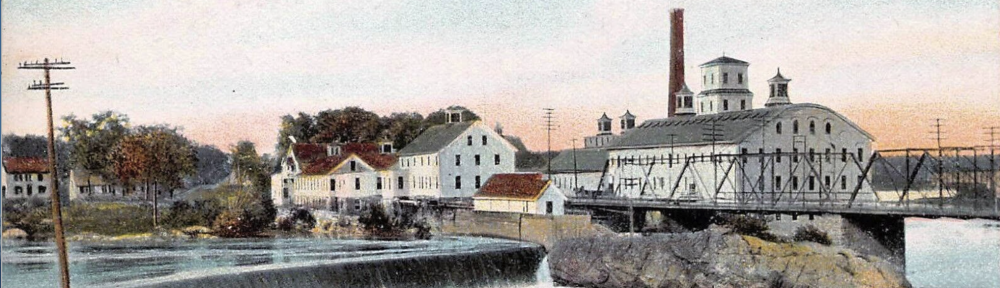
An invitation from the Brunswick Interfaith Council
The agenda and materials for the September 2024 Durham Friends Business Meeting can be found here.
Agenda for Durham Friends Monthly Meeting for Business, October 20, 2024
Acting Clerk, Tess Hartford
a) Ministry and Council- co-clerk Renee Cote
b) Trustees – Sarah Sprogell
c) Peace and Social Concerns – Ingrid Chalifour – no formal report, but many things in progress
d) Finance- no formal report, but a few action items
e) Request for support for the ad hoc committee created for Outreach Activities
DRAFT, September 15, 2024
Ellen Bennett — Recording Clerk
Durham Monthly Meeting of Friends met for the conduct of business on Sunday, September 15, 2024,
with 6 people in attendance at the Meetinghouse and 2 via Zoom.
1. Meeting Opening
Tess Hartford, serving as Clerk of the meeting, opened the meeting with thanks for another beautiful day for gathering followed by a moment of silence.Followed by a reading:
Quoted from the “Wisdom of Yogananda, volume 7”
Give to God not only the good that you do, but also the bad. I do not mean that you should deliberately do things that are wrong. But when you cannot help yourself because of too-strong habits, feel that God is acting through you. Make HIM responsible. He likes that!
It is He after all, who has dreamed your existence. You have merely hypnotized yourself with the thought of your weaknesses. If you make the Lord responsible for your weaknesses, it will help you break the false hold they have on your imagination. You’ll find it easier, then, to recognize in yourself the perfect image of God.
As long as you are making the effort, God will never let you down!
2. Approval of Minutes of July 2024 — Ellen Bennett
Meeting approved the minutes.
3. Ministry and Counsel — Tess Hartford and Renee Cote
Meeting Care Coordinator Support Committee will discuss publishing an MCC report for a wider audience, quarterly, via the newsletter
A Meeting representative to LACO was discussed, stepping in for the current representative who will be stepping off after the October meeting. Kim Bolshaw requested information so that she might attend the October meeting.
A listening session is scheduled for September 22nd, at the rise of meeting, pertaining to technology during meeting for worship.
4 Peace and Social Concerns — Ingrid Chalufour
The committee report was read aloud. In addition, the committee hopes to get social justice book/Wabanaki reading materials into every classroom at the Kate Furbish Elementary School in Brunswick.
Connecting with the Durham elementary school was discussed. A meeting member has contacts at the Durham elementary school and offered to facilitate a connection. It was noted that it is important to strengthen our ties to Durham and Lisbon. The Meeting’s 250th anniversary celebration is one avenue to do this, and representatives from the town of Durham have been receptive to initial inquiries about collaboration around this milestone. It was noted that many students from Durham go on to Freeport HS.
The question arose as how DFM came to occupy/own the land the Meetinghouse sits on. Historical deeds for the meetinghouse property are available that may provide some answers to this question. It is a something to highlight for the anniversary celebration
5. Finance Committee — Nancy Marstaller
Looking at the financial report, the largest concern is that weekly contributions are down significantly. The question was raised: Is second quarter income from these contributions typically low? It was suggested that the newsletter include a note to encourage continued weekly giving. The mentions should also highlight the fact that automatic monthly donation are an easy way to support the Meeting, and forms to initiate this are available via Sarah. It was suggested that a “one click” option, via technology, be explored.
There is $7,000+ in charity account. The Meeting agreed to propose ongoing support through Friends United Meeting for the Turkana and Samburu Friends Missions in the amount of $100/month for one year, for a total of $1200. This proposal will be be revisited for approval at the October meeting for business.
The Meeting expressed its deep appreciation to Nancy Marstaller for overseeing the work on the budget. Finding a Treasurer that has the financial background and skill set to pick up this work is important.
6 Trustees Report — Kim Bolshaw
Report was read aloud.
Doug Bennett gave an update on the settlement of the Eileen Babcock estate. The financing for a lawyer, should it be needed, has been approved.
7. Other Business
Announcement: MCC stipend is being used to support Friends’ initiatives. Some funding is going to support Anna Fritz, accomplished musician from Multnomah Meeting.Anna is on tour to provide performances for prison inmates. Anna will be in Maine in October, performing a contemporary version of the Iliad. Two community performances will be held in the area, one at the Friends School of Portland and the other at the UU Church in Rockland.
8. Closing Worship
Clerk expressed gratitude to those in attendance for service to the Meeting, followed by closing silent worship.
Respectfully submitted, Ellen Bennett, Recording Clerk
Attachments: https://www.durhamfriendsmeeting.org/?p=7184
From Mt. Toby Meeting, on October 9, regarding their member Jan Hoffman:
Friends:
Over the last week, Jan’s condition has continued to worsen. Yesterday, Ken and Jennie (Jan & Ken’s daughter) decided to place Jan in palliative care. Today her condition continued to decline and she was placed in hospice. Ken & Jennie have decided to have Jan remain at Baystate during this last phase of her life. She is resting comfortably with Ken at her side. Please hold Jan, Ken, and their family in the Light.
When the time comes Jan will be buried at Mt. Toby in a green burial.
Peace
Cynthia Jacelon
Jan passed on October 10, 2024.
Here’s a link to an essay Jan Hoffman wrote about Clearness Committees.
Durham Friends Woman’s Society Meeting Minutes, September 16, 2024
The meeting was held at Nancy Marstaller’s home.
Present: Dorothy Curtis, President, Nancy Marstaller, Treasurer. On Zoom: Susan Gilbert, Secretary, Dorothy Hinshaw, Martha Sheldon, Leslie Manning, and Qat Langelier.
Cards: Nancy will send cards this month, to Friends.
Program and Devotions: We took turns reading from Blueprints “A Holy Joy” by Katherine Murray. Scripture: John 15: 9 – 11. Hymn: “Joys Are Flowing Like a River”. At a time of great stress in Katherine’s young adult life, she envisioned “Joy – if not now, when?” . This calmed her, bringing wonder, curiosity, and humor. Her discovery of joy continued to enhance Katherine’s spiritual development throughout her life.
Minutes: Susan read the 6.17.’24 minutes.
Treasurer’s Report: As of our meeting, we had received $410 in donations for jam, earmarked for LACO. We have a balance of $490.96, with $410 for LACO, leaving $80.96 available. We need to pay dues ($5 per member) and for Blueprints. A separate donation for Dorothy’s relish earned $80, to put toward buying new tablecloths. We discussed donating to Getry Agizah’s program to support education for African youth. Nancy will request an additional contribution from the Charity Fund. Money gained from a silent auction in November could support Tedford.
Prayer’s: For Friends.
Tedford Meal: Team D prepared hot dogs, potato salad and ice cream on September 2. Nancy Marstaller’s Team E will bring the October 7 meal. Volunteer contributions of food or donations are welcome.
Other Business: Durham Friends will host a fundraising dinner for LACO on October 5. Shiloh Chapel and UCC Church of Durham are to share preparations. The Woman’s Society annual potluck supper was held August 19th, combined with a birthday party for Ed Hinshaw. We received a thank you note from the Hinshaws.
Respectfully Submitted, Susan Gilbert
Maker Sessions — A Planning Meeting, October 4, 5pm
Craig, Leslie, Ellen, Doug, Kim, and Ezra have met a couple of times to talk about “Maker Sessions” — a way build community within and beyond Durham Friends Meeting.
Please join us to share ideas, hopes and aspirations at 5 p.m. on October 4 at the Meetinghouse.
A pot-luck “soup-er supper” will be served.
Details about ideas generated up to this point can be found here: https://tinyurl.com/55fea32z And you can always ask questions or send comments to craig@Freshley.com.
In August 2024, around 500 Quakers from 53 countries met for the World Plenary Meeting in South Africa and online to tend to FWCC business, surrounded by worship and fellowship.
This World Quaker Day, Sunday 6 October 2024, Friends everywhere are invited to find out and share what happened at their local Friends church or meeting:
The epistle and a weaving document with a prayer that brings together the different plenary conversations are all available in the conference languages, KiSwahili, Spanish and English.
“God has no hands but ours, no feet but ours, no lips but ours, so we keep imagining a better world. I am because you are. I am because we are. I see you. We belong to each other. We are still here. We are one.”
—from the World Plenary epistle
“God of love and grace, we are a beautiful and broken people, living in a beautiful and broken world… Grant us the strength to seek each other’s forgiveness, and the love and courage to hold both pain and possibility in our hearts.” —from the weaving document prayer
The Young Adult Friends epistle, relating the experience of 46 18-35 year-olds who gathered four days before the World Plenary and who formed a new World Executive Committee of Young Adult Friends, is also available in the conference languages.
The epistle will be read at a semi-programmed online meeting for worship hosted by the Europe and Middle East Section, and an event in Uganda organised by the Africa Section. Both are open to all.
Friends may also want to take part by singing from the World Quaker Songbook. To learn the tunes, listen to Quaker and musician, Amy Duckett Wagner sing the songs on our YouTube channel.
Finally, Friends who wish to engage more deeply with the themes discussed at the World Plenary can watch the videos of speakers’ prepared ministry also on YouTube.

 Local Youth Ministries Supporting Each Other (LYMSE) Next session: September 23, 7:00 to 8:00 pm CLICK HERE TO REGISTER FOR THE NEXT LYMSE SESSION |
 Fall Retreats in an Election Year: Fall Retreats in an Election Year:Rebuking the Wind and Waves |
| Junior High Yearly Meeting (JHYM) Fall Retreat for 6-8th graders October 4-6 Portland Friends Meeting Portland, ME Junior Yearly Meeting (JYM) Fall Retreat for 2nd-6th graders November 8-10 Woolman Hill Retreat Center Deerfield, MA to register for events, go to the Youth Ministries Retreats page on the NEYM Website |
 Rebuking the Wind and Waves Rebuking the Wind and WavesWhen I realized that I had scheduled a JYM retreat on the weekend after the election, I gulped. Would we be able to tune out the world just two days after learning the results? Would the staff be ready to answer questions the kids might be asking – questions that adults might be still asking themselves? Did I need to plan multiple contingency schedules to respond to different scenarios, results, and reactions? And what about JHYM – should I be planning a retreat that addressed the rhetoric and controversies that would be undoubtedly swirling around us by October? I conceded that I didn’t have a crystal ball, and realized that I had to plan something that would ‘work’ regardless of the outcome, making space for any outcome and any emotions we may be feeling. Something steadfast. Something hopeful. And it occurred to me that this ‘something,’ this theme, this message, should be the same – unchanging – whether it was a month before the election or two days after. Because our values won’t have changed. God* won’t have changed. Our faith – whether emboldened or shaken – is always relevant. As I meditated on the concept of this no-matter-what faith, I remembered the story of Jesus calming the storm. He was on a boat with his disciples when the storm started. In response to the disciples’ fear, Jesus uttered the famous line, “O ye of little faith.” Jesus had not been afraid. In fact, his mood and behavior hadn’t changed since the calm sea had rocked him to sleep hours earlier! It was only because they woke him up in a panic that he felt the need to do anything at all. And they say he “rebuked the wind and waves,” calming the sea, along the with the fears of the crew. Wind and waves always exist in our lives. Sometimes they are political and societal. They can also be emotional, spiritual, relational, medical, or financial. But we can have hope no matter what. We can have faith no matter what. And this election season is a great time for us all to be reminded of that concept, which we can carry into the rest of our lives. Wherever your child is on the politically savvy spectrum, whatever else they might be struggling with in their life – and even if they are blissfully ignorant of any hardship in the world right now – this theme can speak to them and provide comfort in storms of the present or future. We will explore the aforementioned scripture passage in that open-ended, metaphorical, individualized way that Quakers do. We will play team-building games that are ocean and/or ship themed. We will talk about how to be grounded in our lives. At the retreat in Portland, we will experience waves on a ferry ride. At Woolman Hill we will visit the preserved home of war tax resisters who rebuked the winds of injustice by living simply. Please join us by registering today! In Peace, Kara Price Children and Family Ministries Coordinator New England Yearly Meeting *Sometimes I use the word God to refer to that divine light that exists within and outside of all of us. Sometimes I use other words. The volunteer staff use a variety of words too. Retreats are an opportunity for all of us to ‘listen in tongues’ and learn from and about each other’s spiritual journeys in a mutual respectful way. Similarly, scripture is one of many ways that we can access the divine and explore concepts of faith at this and other retreats.  THANKS FOR A WONDERFUL SESSIONS! THANKS FOR A WONDERFUL SESSIONS!CHILD CARE STAFF Rainer Humphries (Coordinator) Carol Baker (Assistant Coordinator) Brooke Burkett Jennifer Hogue Jerry Carson Mary Lee Morrison Pamela Drouin Paula Rosvall Peter Colby JYM STAFF Kenzie Burpee (Coordinator) Leah Kelley (4-6th Grade Leader) Joli Reynolds (K-3rd Grade Leader) Annie Bingham Craig Jensen Emily Smith Isaac Bingham Luke Coletta Lizzie Szanton Martha Schwope Mary Chenille Rebecca Edwards Sophie Jones Tyler Green JHYM STAFF Emily Edwards (Coordinator) Merritt Bussiere-Nichols (Asst. Coord.) Buddy Baker-Smith (Asst. Coord.) Abigail Adams Amy Greene Ari Schifman Brennon Schifman Chloe Grubbs-Saleem Chris Fitze Dave Baxter |
There will be a LACO Fundraising Dinner at Durham Friends Meetinghouse, October 5, 2024, 4:30 to 6:30 pm.
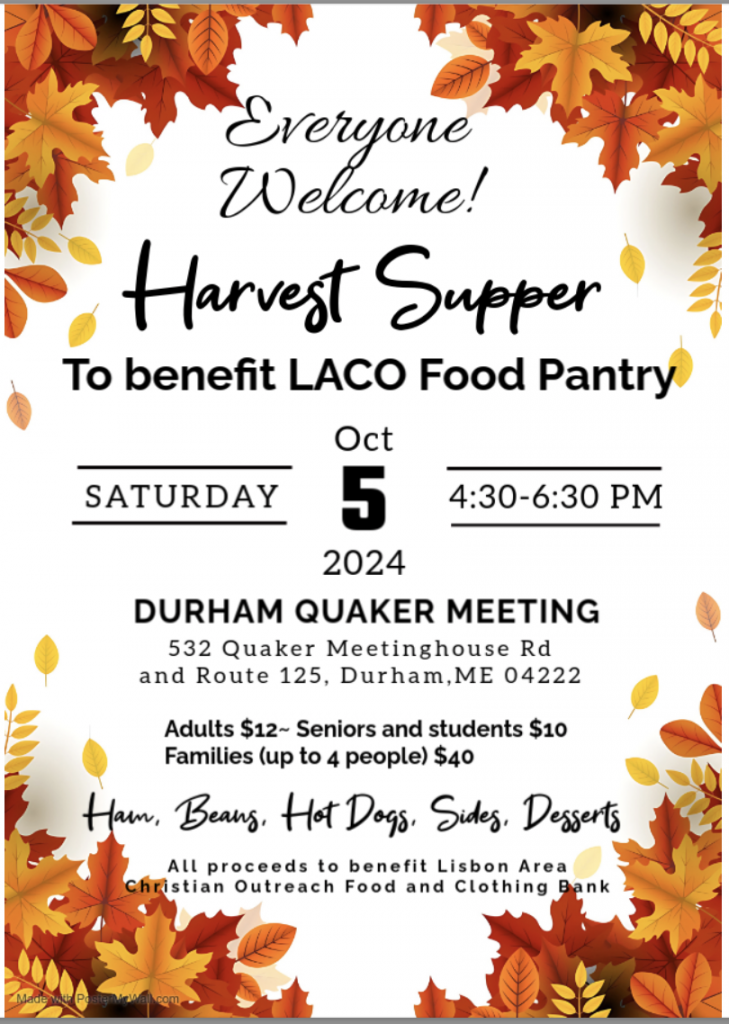
LACO is Lisbon Area Christian Outreach, a food pantry amd clothing bank supported by a number of churches, including this Friends Meeting, in and around Lisbon, Maine.
Ministrfy and Counsel announces:
This Sunday, September 22, we will be having a Meeting-wide listening session to continue our ongoing conversation regarding
the use of Zoom technology in the Meetinghouse during our Sunday worship.
We expect to allot1 hour for the discussion, which we will hold after fellowship and the rise of Meeting. Approximately, from 12:00-1:00 pm.
Please bring your thoughts, comments and questions so that we may discern our way forward with this important aspect of our community life!
Respectfully,Tess Hartford, co-clerk of M&C

The agenda and materials for the September 2024 Durham Friends Business Meeting can be found here.
Agenda
Agenda for Durham Friends Business Meeting September 15, 2024
Clerk, Tess Hartford
1) Meeting Opening
2) Approval of Minutes of July 21, 2024
3) Committee Reports
M&C
PS&C
Finance
Trustees
4) Other business
5) Closing Worship
  Dear Friends Camp Community, Dear Friends Camp Community,Another summer at Friends Camp is complete! We are still reflecting on all the fun and remarkable moments from the last 3 months. This summer saw lots of picturesque days on China Lake, many new friendships made, delicious camp meals, opportunities for growth, and nearly endless laughter. There were 435 campers, and each one of them brought something unique to our community. Though some things about camp remain the same from year to year, the campers and staff present during each unique session are what truly make it special. As always, a huge THANK YOU to everyone who helps make camp possible. We are lucky to have a wonderful network of support coming from families, volunteers, Friends, donors, and more. Thank you especially to everyone who has donated to our campership fund — your contributions continue to provide the opportunity for us to bring as many kids to camp as possible. We hope you enjoy this newsletter! Warmly,Anna HopkinsCamp Director(207) 877-4302director@friendscamp.org2025 Session DatesSee below for the session dates for summer 2025. Registration for a single session per camper will open on Saturday, November 2nd at noon. We anticipate spots being available for some campers who would like to attend multiple sessions, and there will be the opportunity to register for a second session from any remaining spaces on Saturday, November 16th. Information about tuition rates will be finalized in October; we expect a modest increase in tuition.  Common Ground Fair Common Ground Fair Friends Camp is available for cabin and tenting space on Thursday, Friday, and Saturday nights during the Common Ground Fair, Sept 19-21. Space is filling up quickly on Saturday evening, but there is still plenty of space on Thursday and Friday. Learn more about details and rates on our website, and click here to register for your stay.2024 Family Feedback Friends Camp is available for cabin and tenting space on Thursday, Friday, and Saturday nights during the Common Ground Fair, Sept 19-21. Space is filling up quickly on Saturday evening, but there is still plenty of space on Thursday and Friday. Learn more about details and rates on our website, and click here to register for your stay.2024 Family Feedback Thank you to all the campers and families who filled out evaluations about their time at camp this summer! Thank you to all the campers and families who filled out evaluations about their time at camp this summer!Your feedback is valued because it helps inform our understanding of this summer at camp and what to keep or improve on for future summers. Most notable from our 2024 surveys so far is that 100% of respondents made a friend at camp! 2024 Family SurveyCamp Committee Interest FormAre you interested in playing a larger role in the Friends Camp community? Friends Camp is always looking for people who have valuable skills to lend to our committee or sub-committees, soon or in the future. The Friends Camp Committee is part of the governing structure for Friends Camp with specific duties and responsibilities delegated to it by New England Yearly Meeting. The sub-committees include Finance, Health & Safety, Development, Personnel, Buildings & Grounds, and Nominating. The Friends Camp Committee is made up of 10- 15 members, including both Friends and non-Friends who care deeply about Friends Camp. Please fill out the form below if you are interested in becoming a member of the committee or a sub-committee.  Fill out the interest form hereCamp Activities for Back to SchoolAt our end of session fire circle, many campers often talk about wanting to bring the camp spirit home with them. Here are a few activities that we do at camp that you can share with friends, family, peers, or coworkers that can help it feel like Friends Camp is with you year-round! Fill out the interest form hereCamp Activities for Back to SchoolAt our end of session fire circle, many campers often talk about wanting to bring the camp spirit home with them. Here are a few activities that we do at camp that you can share with friends, family, peers, or coworkers that can help it feel like Friends Camp is with you year-round! Young Friends October RetreatThe Young Friends fall retreat is happening October 18 – 20, 2024 at the Portland Friends Meeting. The theme for this retreat is the costumes we wear. Read more below and click the link to register. Young Friends October RetreatThe Young Friends fall retreat is happening October 18 – 20, 2024 at the Portland Friends Meeting. The theme for this retreat is the costumes we wear. Read more below and click the link to register.Each year on the last day of 10th month (October), people across the country don costumes and assume new identities in celebration of Halloween. Though early Friends did not observe this tradition, many Friends today do. But what about the costumes that we try on, both intentionally and unintentionally, during other times of the year? How do the costumes that we wear affirm and how do they obscure our identities? How do the early Friends customs of plain dress and “clothing ourselves in righteousness” resonate with our spiritual practices and traditions today? Join Young Friends for a weekend of silliness, deep conversation, and reflection at Portland Friends Meeting. You can register for the retreat here.Friends Camp Brochures  Do you know of a local place where some Friends Camp brochures might shine? We have informational brochures that can be placed around New England to spread the word about camp to new families. Libraries, community centers, cafés, Meetinghouses, and churches are all great spots for these brochures to live. (Or another place near you that you think would be good!) Fill out this form if you have a local spot where you could post some fliers! Do you know of a local place where some Friends Camp brochures might shine? We have informational brochures that can be placed around New England to spread the word about camp to new families. Libraries, community centers, cafés, Meetinghouses, and churches are all great spots for these brochures to live. (Or another place near you that you think would be good!) Fill out this form if you have a local spot where you could post some fliers! Make a Gift to Friends Camp |
FCNL is asking us to contact our congressional representatives urging support for creation of a Truth and Healing Commission on Indian Boarding School Policies.

Durham Friends folks are invited to Vassalboro Quarterly Meeting’s Fall gathering, Friday and Saturday, Seotember 6&7. The Friday evening session will be via Zoom. The Saturday session will only be in-person at Friends Camp (no Zoom). The full announcement and schedule is below. (Vassalboro is a neighboring Quarterly Meeting; Durham is part of Falmouth Quarterly Meeting.) Note an RSVP is requested if you plan to attend either session.
Friday evening will focus on the spiritual state of member meetings of Vassalboro Quarter. The Saturday program will focus on Friends relations with Native Americans.
Fall Gathering 2024, Sept 6th, 6:30 pm-8pm on Zoom and Sept 7th, 8:30 am- 3pm at Friends Camp, China Maine
“Few are guilty………All are responsible” Rabbi Abram Joshua Heschel
“A sower went out to sow his seed. And as he sowed, some fell by the wayside; and it was trampled down, and the birds of the air devoured it. 6 Some fell on rock; and as soon as it sprang up, it withered away because it lacked moisture. 7 And some fell among thorns, and the thorns sprang up with it and choked it. 8 But others fell on good soil, sprang up, and yielded [a]a crop a hundredfold.” When He had said these things He cried, “He who has ears to hear, let him hear!” Luke 8: 5-8
Greetings , Friends,
Many “seeds” were sown during Yearly Meeting sessions this August. We were asked to have ears to hear so that we may be the “good soil” and yield.
We were also told of some of our Quaker history and involvement in the Indian Boarding Schools in the 1800-1900’s.
Through the deep and personally-grounded messages, we, as a body, discerned the way forward on the heavy issues facing us.
So, for this Fall Gathering, we wanted to hear the voices from Friends in Maine (all of you!) on what is lifting you up? How are you led, and how do you prepare the soil? How do you nourish the seeds of good within and around you?
On Friday evening, we will be hearing highlights from our monthly meeting’s spiritual life, “state of society,” and reflecting on how those “seeds,” from other monthly meetings, find soil in us to start to grow towards the Light.
On Saturday morning, we will be hearing from two Friends. First, Shirley Hager will share how she came to her most recent leading to foster creation of a program of support for first time Wabanaki university students. Then we will hear from Janet Hough and how following her current deep dive into the Friends Indigenous Boarding school’s is changing her. We will have worship following each offering and a chance to reflect and share.
On Saturday afternoon, there will be a choice to have discussion and open sharing about either:
1) diving deeper into what is rising up for us when we hear of historic & present indigenous oppression
or
2) what is rising up in our response to other injustices
Please save the date and spread the word of Fall Gathering , on the weekend after Labor Day, Fri. Sept 6 and Sat.Sept.7th.
Friday, Sept 6th on Zoom from 6:30-8 pm; a link will be sent
Saturday, Sept 7th in-person at Friends Camp (no Zoom) under the tent or in the Aviary, if the weather requires
See next page for more information about hospitality & Saturday’s schedule
Saturday schedule
8:30 am : Fellowship with refreshments and finger foods
9-10 am : Intro and worship sharing on the Parable of the seed and the soil.
10:15-11 am : Shirley Hager: “The Evolution of a Leading: Way Keeps Opening,” followed by worship sharing
11:00 am: Janet Hough will share about her journey exploring NEYM’s involvement in Quaker Indigenous Boarding Schools, followed by worship sharing;
12:00 pm Lunch (soups from Vassalboro MM), veggies, fruit, salads, breads from other attenders
1: 15pm-2:30pm Break into group of choice for sharing
2:30- 3pm Sharing reflections from the day
For those who would like to stay with Vassalboro Friends on Friday or Saturday evenings, hospitality is offered at the contact below.
Please bring a veggie, fruit, salad or bread to offer for lunch. A choice of soups is provided by Vassalboro MM Friends.
A link for Friday eve will be sent the week prior to all on this email list. If you didn’t receive this email directly from Janet, please ask to be added to the list if you wish to receive further correspondence and the link directly.
FMI or hospitality questions…………Holly Weidner weidnerholly@gmail.com or 649-1305
RSVP is appreciated for Friday and Saturday attendance but not required.
Feel free to invite others who you feel may be interested in joining us for this day of sharing and listening.
From Woman’s Society:
Please join the Woman’s Society Potluck Dinner Monday, August 19 at 6 PM at the Meeting House. All are welcome!
Durham Monthly Meeting of Friends met for the conduct of business on Sunday, July 21, 2024, with 10 people in attendance at the Meetinghouse and one attending by Zoom. Tess Hartford clerked the meeting.
Meeting approved Tess Hartford as Clerk of July Monthly Meeting for the conduct of business.
2. Meeting Opening
To continue Meeting for Worship, Clerk read from the book “Christian Meditation” by James Finley. Harper Collins, 2004.:
“Saint Paul writes in his Letter to the Philippians, ‘In your minds you must be the same as Christ Jesus’ (Phil. 2:5). We become the same as Christ Jesus in our minds through a lifelong process of conversion in which Christ’s mind and our mind become one mind, one way of seeing and being in the world. The faithful practice of meditation is a way of learning to follow the spirit’s prompting in being led along this self-transforming path into the mind of Christ. Let us then explore the ways in which we enter Christ’s mind in meditation. Such an inquiry will take us into the innermost recesses of Christian faith. These inner recesses consist of neither beliefs nor institutional structures, but rather a self-transforming journey into the vibrant center of reality itself As our inquiry unfolds, a portrait of Christ will emerge in which we can recognize our own true face as one destined by God to be one with God forever.” pp. 175
3. Approval of Minutes of June 16 2024 — Ellen Bennett
Meeting approved the minutes of the June meeting for business.
4. Ministry and Counsel — Renee Cote
Renee summarized the meeting for worship schedule for message-givers and Zoom availability for the next several weeks.
Discussion ensued about a memorial service for Lyn Clark. Considered were a special meeting, a meeting for remembrance in October for all who have passed, and honoring Lyn as part of a regular unprogrammed meeting for worship. It was agreed to note particularly what Barbara Simon had written and read to us about Lyn. The unprogrammed Meeting scheduled for August 25 was lifted up as a possibility that included inviting Barbara Simon and asking person responsible for Care of Worship to read her statement at the start of meeting.
Meeting approved M&C continuing their discussion of this, as well as the handling of memorial meetings/services in general.
M&C was asked to talk to individuals about what they would like regarding their own memorial gathering/meeting.
5. Trustees Report — Sarah Sprogell
Sarah read the Trustee Report aloud.
Trustees are asking for approval to continue their work with respect to the bequest of an estate of a former member. Trustees are also asking for approval, should it be necessary, to use up to $10,000 to pay for legal representation in pursuit of this matter. Trustees will seek out all avenues to resolve the situation before turning to hiring an attorney.
Meeting approved that Trustees continue to pursue the matter.
Meeting approved use funds up to $10,000, if necessary.
Clerk reaffirmed the Meeting’s trust in Trustees, and asked for prayers for their continuing efforts.
In addition, a member expressed gratitude to Sarah Sprogell, which the Meeting shared, for her attention to the condition of our beloved Meetinghouse.
6. Other Business
For everyone’s information, Ellen described the formation of an ad hoc event-planning working group. The group was asked to remember logistics, specifically with respect to the meeting calendar!
Meeting agreed that any members of Durham Friends Meeting who attend business sessions at NEYM be considered representatives of the Meeting.
The next business meeting will be held September 16th.
7. Closing Worship
Respectfully submitted, Ellen Bennett, Recording Clerk
Materials for the July 21, 2024 Meeting for Worship for Business can be found HERE (to be posted by Friday evening).
AGENDA FOR THE CONDUCT OF BUSINESS FOR DURHAM FRIENDS MONTHLY MEETING
1) Approval needed for Tess Hartford to Clerk the Monthly Meeting for July through September
Tess will offer an opening prayer/reading for Worship
2) Approve June 16, 2024 Business Meeting Minutes. Any additions, questions or corrections?
3) Report from Ministry and Counsel
4) Report from Trustees
5) Finance committee and Peace and Social Concerns do not have reports this month
6) Other business
7) Close with waiting worship
Durham Friends Woman’s Society Meeting Minutes 6.17.’24
We gathered at the Meeting House and Dorothy Hinshaw joined us on Zoom.
Present: Dorothy Curtis, President, Susan Gilbert, Secretary, Kim Bolshaw, Dorothy Hinshaw.
Cards: For Friends.
Program and Devotions: Kim read for Blueprints “Giving Thanks for Love Unexpected” by Nellie Malloy. Scripture Ephesians 3:20, John 14:1, Isaiah 65:24a, Jeremiah 29.11. Song: More Love to Thee, and Make Me a Blessing. Nelly is a member of Cascade Quaker Meeting, a small meeting high in the northern Blue Mountains of Jamaica. Experiencing deep grief at the loss her husband and son to cancer, Nellie found comfort in God’s love. When faced by a possible cancer diagnosis herself, panic and fear were soothed as she studied her Bible and asked her meeting and family for prayers. Further tests did not reveal cancer. Through her life’s challenges, Nellie’s love and gratitude for God has deepened.
Minutes: Susan read the 6.20.’24 minutes, written by Nancy Marstaller.
Treasurer’s Report: The Woman’s Society account gained $942. from the plant sale, plus $45. in donations. Balance $1012.96.
Prayer’s: For Friends.
Tedford Meal: Prepared by Kim’s Team A, the meal was Mac and cheese, with or without ham, bananas, clementines and apples, little carrots and salad dressing, with ice cream for dessert. The July 1st meal will be brought by Team B. Volunteer contributions of food or donations are welcome.
Other Business: We discussed having another silent auction this year, to be planned at our next meeting in September. We will not meet in July, and on August 19th we will have our annual Woman’s Society dinner, all Friends and friends welcome.
Dorothy closed the meeting with a reading of Thomas à Kempis:
“Have confidence in God’s mercy, for when you think He is far from you, He is…near.”
Respectfully Submitted, Susan Gilbert
Meet Mary Rowlandson, presented by Quaker storyteller Katie Green
Friday, July 19 at 7 PM, Durham Friends Meeting
Based on her own account, Mary speaks of her capture by Native people during Metacom’s Rebellion, aka King Phillip’s War, in 1670’s Massachusetts.
This challenging narrative will be followed by discussion on issues that remain important today- racism, theocracy and right relationship with Indigenous neighbors.
It will also be made available by Zoom; please email durham@neym.org for details.

